Showing posts with label Female Explorers. Show all posts

Sunday, December 5, 2010

Explorer or Bucket Carrier?

 
Many intrepid women have been involved with African exploration - with just two being the subjects of my most recent blogs - but what does it say about a country which occupies almost an entire continent and has no major female figures connected with its exploration?
The Australian Women's Register does not list any female explorers at all, in spite of the extensive list of occupations in which one can find many inspirational and adventurous Australian women.
Emily Caroline Robinson, later Creaghe, then Barnett, is given a single line:
Creaghe was the only woman member of Ernest Favenc's exploring party across Northern Australia in 1883.
However, the Register does include a link to her diary in the State Library of New South Wales which provides a few more details.
The Australian Dictionary of Biography has 234 names listed under the occupation of "Explorer" and Emily Caroline Barnett is the sole woman!
The truth is that she only seems to rate a mention because of the rediscovery of her diary and its publication in 2004, edited by Peter Monteath. This was followed in 2007 by an expedition in Emily's footsteps by the artist, Gemma Lynch-Memory, who took inspiration from Emily's journey to produce a series of paintings. According to Gemma's website this came about:
"After finding a copy of Emily's diary in a second-hand bookshop, Gemma became the first person to retrace the outback journey of Australia's first female explorer, Emily Caroline Creaghe. ... The expedition was featured on the ABC 7:30 Report and Gemma was recognised by the International Society of Female Explorers [sic] * based in New York. The touring exhibition received critical acclaim and was also featured in Australian Art Review magazine."

* There is no such organisation - possibly should read the Society of Women Geographers based in Washington, DC.
So what exactly did Emily Caroline do to finally bust through the gender barrier of Australian exploration? Apart from the summary offered by the ADB, the best account of her travels is in this article written for the National Library of Australia news magazine in 2006 by Judy Cannon.
The newspaper reports of the time mostly ignored her or simply included her as some kind of afterthought, as per this entry from The Maitland Mercury in July, 1883:
"Creaghe and party arrived at Catherine Waters accompanied by his wife"
while the South Australian Register accords her a bit more credit as:
"... the first lady who has made such an adventurous trip in Australia."
But was she truly an explorer in her own right, or was she unfortunately an appendage - a cook, bottle-washer and bucket-carrier - much like Mary Livingstone and similar wives who simply went along with adventuring husbands rather than be left behind?  This review by Gillian Dooley on the publication of her diary is somewhat scathing, as it does not show Emily Caroline in any particularly brave or inspiring light that would qualify her for the title of "explorer".
Emily Caroline Creaghe Barnett had another adventure later in life when in 1899, she was interviewed by the Sydney Morning Herald after an abortive trip to New Zealand during which the ship in which she was travelling lost its screw and subsequently spent seven weeks drifting and wallowing about the stormy Tasman Sea until rescue. Having to endure this discomfort with five children and a maid made two whole columns of print - considerably more than anything this first female "explorer" had accomplished in her crossing of the Outback in 1883.
It is rather disappointing that there are no other recorded important journeys by women across Australia during the exploration era. In the eyes of the Europeans of the time, the continent was seen to be unromantic and empty, with boring vistas and little of interest to discover either in the way of animals or people, even native plants were seen as prickly and unattractive. Australia certainly doesn't seem to have captured the imagination of wealthy adventuring women like May French-Sheldon or Alexine Tinne.  (Stories posted previously.)
So were all women tramping about remote areas of Australia in late 19th and early 20th Century mostly appendages and bucket carriers? It could seem that way, although this letter to the editor of the Northern Territory Times in 1921 hints that there were other women out there - tough, unsung pioneers who were probably too busy getting to where they were going by whatever route and means possible and had no time to bother with the frivolities of journals or diaries.


Tuesday, November 2, 2010

Bebe Bwana. A Woman in Darkest Africa

A curious snippet in The Launceston Examiner (Tasmania) of 7 January 1891 reads as follows
A FEMALE AFRICAN EXPLORER
Mrs. Sheldon, an American lady, contemplates exploring Central Africa with a body guard of soldiers, who will be negresses
The images created by this report sent me scurrying to discover more. Who was Mrs. Sheldon and did she really have “negresses” as a bodyguard while exploring Central Africa?
Another slightly more accurate report in The Advertiser (Adelaide) of the same date states that Mrs. Sheldon, is “the widow of an American congressmen” and her body guard will include both “soldiers and negresses”. Six months later, another brief report in The Advertiser states:

MRS. SHELDON
Ill at Zanzibar.
June 19

Mrs. French-Sheldon, the American lady who recently undertook to explore Darkest Africa, is lying dangerously ill at Zanzibar. She sails for England at the earliest opportunity.
Further trawling of old newspaper reports revealed much more about this intriguing woman, that Mrs. Sheldon not only survived her illness at Zanzibar but went on to have many more adventures in Africa.
She was not yet a widow when she started out on her epic journey in 1891 and, most importantly, Mrs. Mary [or May] French-Sheldon, known to the Africans as "Bebe Bwana", in 1910, became the one of the first women to be appointed a Fellow of the Geographical Society.
She had already travelled around the world by the age of sixteen and later qualified as a medical doctor, ran a publishing company and wrote several books. She was friends with the explorer, Henry Morton Stanley, and was one of the few people not to condemn him over the atrocities with which he was reportedly connected in the Congo.
Mrs. Sheldon’s best-known work is a well-illustrated book about her first foray, called “Sultan to Sultan: Adventures among the Masai and other tribes of East Africa 1892”. From her book, it seems her ambition to take women porters wasn’t all that successful, as she says :
Although I had been strongly advised to take women porters to wash and for other duties, I found the few that I had were a perpetual nuisance. They were always inciting disputes among the porters, and resorted to all sorts of measures to win from them portions of food and other things which they coveted.
She goes to describe one tiny woman who ate so much she ended up “like a fatted pig” by the end of the safari and who was always in danger of being washed away when they crossed rivers so that Mrs Sheldon had to detail a male porter to look after her.


Unnamed female porters
However, I have this to say of the women porters, they compared admirably with the men both in staying qualities and strength, doing their day’s march with no more complaining, besides having superficial duties either incumbent upon them or volunteered, which the men had not.
One worthy addition to Mrs. Sheldon’s book is that unlike the books of most male explorers, she has taken the trouble to carefully list all 153 names of every porter or askari (soldier) who helped her.
Maybe there is some descendant in East Africa who knows what happened to some of the five women porters: Lidia, Beda, Suzzan, Burt Hamis and Burt Hamis Mzuria, but it is most unlikely as native people like them who helped white explorers are all long lost to history.
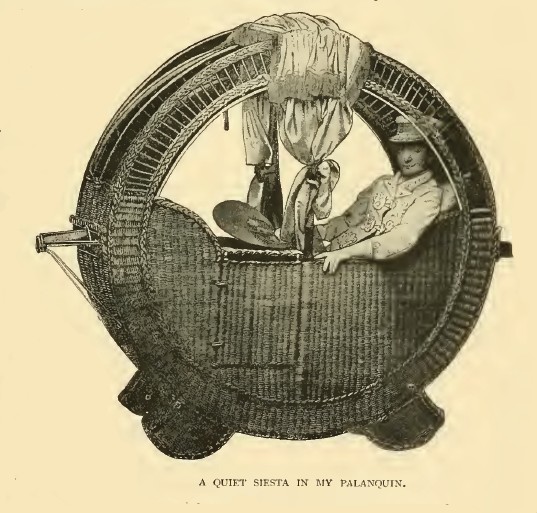
Mrs. Sheldon’s unique cane and bamboo palanquin was designed by her friend Henry S. Wellcome (founder of the pharmaceutical company that is now GlaxoSmithKline) and it was described in one newspaper report as containing all the comforts and luxuries of a Pullman palace car. There has probably been nothing quite like it in African safaris, before or since! On one occasion, a 15ft long python took a fancy to it and on waking up to discover this giant creature wrapped over her gave even the tough and redoubtable Mrs. Sheldon a case of the vapours!
Mrs. Sheldon's book can be found at the Internet Archive, and she is also the subject of a recent feminist biography "The White Queen" by Tracey Jean Boisseau, published by Indiana University Press.

All images from "Sultan to Sultan" and the Library of Congress.


Mrs. Sheldon's Guns