Sunday, December 5, 2010

Explorer or Bucket Carrier?

 
Many intrepid women have been involved with African exploration - with just two being the subjects of my most recent blogs - but what does it say about a country which occupies almost an entire continent and has no major female figures connected with its exploration?
The Australian Women's Register does not list any female explorers at all, in spite of the extensive list of occupations in which one can find many inspirational and adventurous Australian women.
Emily Caroline Robinson, later Creaghe, then Barnett, is given a single line:
Creaghe was the only woman member of Ernest Favenc's exploring party across Northern Australia in 1883.
However, the Register does include a link to her diary in the State Library of New South Wales which provides a few more details.
The Australian Dictionary of Biography has 234 names listed under the occupation of "Explorer" and Emily Caroline Barnett is the sole woman!
The truth is that she only seems to rate a mention because of the rediscovery of her diary and its publication in 2004, edited by Peter Monteath. This was followed in 2007 by an expedition in Emily's footsteps by the artist, Gemma Lynch-Memory, who took inspiration from Emily's journey to produce a series of paintings. According to Gemma's website this came about:
"After finding a copy of Emily's diary in a second-hand bookshop, Gemma became the first person to retrace the outback journey of Australia's first female explorer, Emily Caroline Creaghe. ... The expedition was featured on the ABC 7:30 Report and Gemma was recognised by the International Society of Female Explorers [sic] * based in New York. The touring exhibition received critical acclaim and was also featured in Australian Art Review magazine."

* There is no such organisation - possibly should read the Society of Women Geographers based in Washington, DC.
So what exactly did Emily Caroline do to finally bust through the gender barrier of Australian exploration? Apart from the summary offered by the ADB, the best account of her travels is in this article written for the National Library of Australia news magazine in 2006 by Judy Cannon.
The newspaper reports of the time mostly ignored her or simply included her as some kind of afterthought, as per this entry from The Maitland Mercury in July, 1883:
"Creaghe and party arrived at Catherine Waters accompanied by his wife"
while the South Australian Register accords her a bit more credit as:
"... the first lady who has made such an adventurous trip in Australia."
But was she truly an explorer in her own right, or was she unfortunately an appendage - a cook, bottle-washer and bucket-carrier - much like Mary Livingstone and similar wives who simply went along with adventuring husbands rather than be left behind?  This review by Gillian Dooley on the publication of her diary is somewhat scathing, as it does not show Emily Caroline in any particularly brave or inspiring light that would qualify her for the title of "explorer".
Emily Caroline Creaghe Barnett had another adventure later in life when in 1899, she was interviewed by the Sydney Morning Herald after an abortive trip to New Zealand during which the ship in which she was travelling lost its screw and subsequently spent seven weeks drifting and wallowing about the stormy Tasman Sea until rescue. Having to endure this discomfort with five children and a maid made two whole columns of print - considerably more than anything this first female "explorer" had accomplished in her crossing of the Outback in 1883.
It is rather disappointing that there are no other recorded important journeys by women across Australia during the exploration era. In the eyes of the Europeans of the time, the continent was seen to be unromantic and empty, with boring vistas and little of interest to discover either in the way of animals or people, even native plants were seen as prickly and unattractive. Australia certainly doesn't seem to have captured the imagination of wealthy adventuring women like May French-Sheldon or Alexine Tinne.  (Stories posted previously.)
So were all women tramping about remote areas of Australia in late 19th and early 20th Century mostly appendages and bucket carriers? It could seem that way, although this letter to the editor of the Northern Territory Times in 1921 hints that there were other women out there - tough, unsung pioneers who were probably too busy getting to where they were going by whatever route and means possible and had no time to bother with the frivolities of journals or diaries.


Monday, November 29, 2010

A trifle too seraphic ... Mademoiselle Tinne

Mademoiselle Tinne
Continuing with my current interest in female explorers, I note that this amusing bit of doggerel from Punch in June, 1893 has been included in a number of books and essays about the subject.

Lady an explorer? a traveller in skirts?
The notion's just a trifle too seraphic:
Let them stay and mind the babies, or hem our ragged shirts;
But they mustn't, can't and shan't be geographic.

Unlike women today who can grab a back-pack, jump on a plane and be in the remotest corner of the world within hours, the adventurous female who set off to explore unknown horizons in the 19th Century usually came from a privileged class. She would have had to have a certain amount of freedom and independence, financial security and a network of important connections. If she had children, she would probably have had someone else look after them anyway and any mending was always done by maids even when tramping about deserts. So it is hardly surprising when researching female explorers from this era to discover they were usually highly accomplished individuals, confident, well-educated and wealthy.
Alexine about to receive her death blows
 Alexandrine (Alexine) Tinne's father was a Dutch diplomat and entrepreneur who died in 1844 when Alexine was eight years old, leaving his wife and daughter one of the largest fortunes in the Netherlands at the time. From a young age, Alexine had a passion for the piano, languages and travel. According to some biographical articles, there seems to have been a brief romance that didn't amount to much. Together with her mother, and later an aunt, who became known as the Dutch Ladies Tinne, she travelled widely in Europe and later through Egypt and the Sudan. Alexine's mother and aunt both died from illnesses at Khartoum and Alexine herself was killed by Tuaregs on a subsequent expedition.
Various reports of Alexine's short life of 34 years are to be found on the Internet, many of them in Dutch or other languages. An English account appeared in Aramco magazine in 1983 although it conflicts somewhat with that provided by the Institute of Dutch History, particularly regarding Alexine's rather gruesome end.
 Like other female explorers of their age, the Tinne ladies did not travel "light". According to whichever report you believe, they had Dutch sailors and/or Irish porters to help them and Alexine took a heavy iron bed with her as well as porcelain china and silver tableware.
Apart from her exploring endeavours, Alexine has other claims to fame. She was also a highly accomplished photographer and some of the earliest photographs of The Hague were the work of Alexine Tinne.

The Hague c. 1860, photograph by Alexine Tinne
A genus of plants have also been named after her plantae tinneanae, and a book was published with her discoveries. See Botanicus. Unfortunately, most of the specimens and artefacts from her exhibitions were destroyed during the war.
Alexine Tinne is much better known in Continental Europe than in English-speaking countries. A number of books have been written about her and she has also been included in various anthologies of female explorers. A book in English about the three Ladies Tinne was published earlier this year (2010) The Dutch Ladies Tinne, in the Sudan by Anna Maria Abushama-Rademaker.

Dutch Ladies Tinne at Khartoum


Miss Tinne at Gerard Rohlfs' camp Tripoli 1869 (British Library)
(Note: copyright of some images in this post have been difficult to etablish with certainty as they are on non-English websites.)


Tuesday, November 2, 2010

Bebe Bwana. A Woman in Darkest Africa

A curious snippet in The Launceston Examiner (Tasmania) of 7 January 1891 reads as follows
A FEMALE AFRICAN EXPLORER
Mrs. Sheldon, an American lady, contemplates exploring Central Africa with a body guard of soldiers, who will be negresses
The images created by this report sent me scurrying to discover more. Who was Mrs. Sheldon and did she really have “negresses” as a bodyguard while exploring Central Africa?
Another slightly more accurate report in The Advertiser (Adelaide) of the same date states that Mrs. Sheldon, is “the widow of an American congressmen” and her body guard will include both “soldiers and negresses”. Six months later, another brief report in The Advertiser states:

MRS. SHELDON
Ill at Zanzibar.
June 19

Mrs. French-Sheldon, the American lady who recently undertook to explore Darkest Africa, is lying dangerously ill at Zanzibar. She sails for England at the earliest opportunity.
Further trawling of old newspaper reports revealed much more about this intriguing woman, that Mrs. Sheldon not only survived her illness at Zanzibar but went on to have many more adventures in Africa.
She was not yet a widow when she started out on her epic journey in 1891 and, most importantly, Mrs. Mary [or May] French-Sheldon, known to the Africans as "Bebe Bwana", in 1910, became the one of the first women to be appointed a Fellow of the Geographical Society.
She had already travelled around the world by the age of sixteen and later qualified as a medical doctor, ran a publishing company and wrote several books. She was friends with the explorer, Henry Morton Stanley, and was one of the few people not to condemn him over the atrocities with which he was reportedly connected in the Congo.
Mrs. Sheldon’s best-known work is a well-illustrated book about her first foray, called “Sultan to Sultan: Adventures among the Masai and other tribes of East Africa 1892”. From her book, it seems her ambition to take women porters wasn’t all that successful, as she says :
Although I had been strongly advised to take women porters to wash and for other duties, I found the few that I had were a perpetual nuisance. They were always inciting disputes among the porters, and resorted to all sorts of measures to win from them portions of food and other things which they coveted.
She goes to describe one tiny woman who ate so much she ended up “like a fatted pig” by the end of the safari and who was always in danger of being washed away when they crossed rivers so that Mrs Sheldon had to detail a male porter to look after her.


Unnamed female porters
However, I have this to say of the women porters, they compared admirably with the men both in staying qualities and strength, doing their day’s march with no more complaining, besides having superficial duties either incumbent upon them or volunteered, which the men had not.
One worthy addition to Mrs. Sheldon’s book is that unlike the books of most male explorers, she has taken the trouble to carefully list all 153 names of every porter or askari (soldier) who helped her.
Maybe there is some descendant in East Africa who knows what happened to some of the five women porters: Lidia, Beda, Suzzan, Burt Hamis and Burt Hamis Mzuria, but it is most unlikely as native people like them who helped white explorers are all long lost to history.
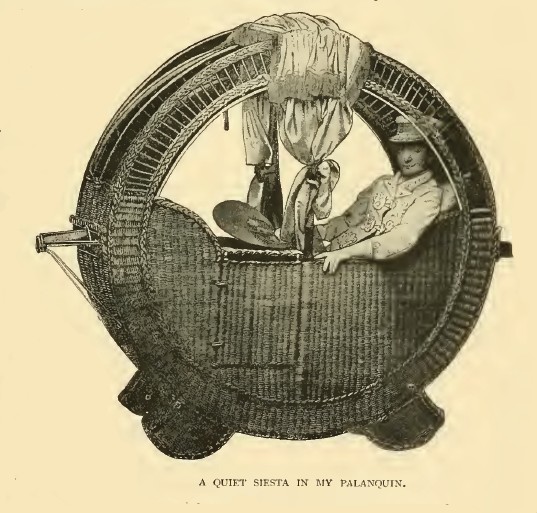
Mrs. Sheldon’s unique cane and bamboo palanquin was designed by her friend Henry S. Wellcome (founder of the pharmaceutical company that is now GlaxoSmithKline) and it was described in one newspaper report as containing all the comforts and luxuries of a Pullman palace car. There has probably been nothing quite like it in African safaris, before or since! On one occasion, a 15ft long python took a fancy to it and on waking up to discover this giant creature wrapped over her gave even the tough and redoubtable Mrs. Sheldon a case of the vapours!
Mrs. Sheldon's book can be found at the Internet Archive, and she is also the subject of a recent feminist biography "The White Queen" by Tracey Jean Boisseau, published by Indiana University Press.

All images from "Sultan to Sultan" and the Library of Congress.


Mrs. Sheldon's Guns


Sunday, September 19, 2010

From the cave to the pole?

This wonderful cartoon image by Australian illustrator Matt Davidson says something about the achievements of feminism since the days of the cave-persons. It is amusing, but also rather alarming. What would the sufragettes have thought about a generation of women who think that sliding around almost naked on a pole is some kind of achievement for female equality?  Are we in danger of joining a slippery slide back to the caves? The article by Ardyn Bernoth that accompanies the cartoon can be read here.

Wednesday, September 15, 2010

Queens of Coal

There is currently a special exhibition on at the UK National Coal Mining Museum on the Coal Queen Beauty Pageant which ran in the 1970s and 1980s, but this seems such superficial objectification-of-women nonsense when compared to the backbreaking work of these girls' bucket-carrying female ancestors who are the true queens of coal and who worked in and around the collieries of Great Britain during the 19th century.

Up until 1842, women and children worked underground for a pittance doing hard labour that even robust men avoided or would find difficult. Some women actually wielded picks, but most were just treated as beasts of burden. They carried coal in baskets on their backs as they climbed up stairs out of the mine and in some collieries, they even had chains around their waists in order to haul wagons through narrow passages on all fours. Conditions were abysmal, the working day was long and there were no occupational health and safety regulations, and women and children were almost considered dispensible by many colliery owners. The accident rate was high - from falls or encounters with machinery and railtracks - some of which might have occurred due to the cumbersome female clothing of the era. Testimony evidence given to the Ashley Commission makes for distressing reading. Some women endured miscarriages as a result of the work and even after giving birth they would be expected to be back at work the next day. Some examples of the evidence can be read on the Victorian Web here
After the 1842 reforms initiated by Lord Shaftesbury came into force, women and children were banned from working underground but they were given other surface jobs such as sorting and screening coal by hand. But this was also arduous dirty work and they still had to carry coal in baskets on their backs. 
A DVD has been produced by a local English history group about these often-forgotten women. To the men they might have been called the "Pit Brow Lasses", but they really were Coal Queens.

Saturday, August 7, 2010

Pressgangs and Poetry

As often happens when going in search of women whose achievements have been obscured by history, the route can be an interesting and serendipitous journey in itself. After reviewing “A Merciless Place” in my previous post, I was intrigued to find out more about any individuals – men or women - who had endured and survived the late 18th and early 19th century tragedies and horrors of West Africa as so vividly described in that book. One diversion led me to the Royal Naval doctor in Sierra Leone, Dr Thomas Masterman Winterbottom, an early researcher into sleeping sickness and later founder of the South Shields Maritime College (now South Tyneside College), among his numerous achievements. Clearly he survived “the white man's grave” as he lived to the ripe old age of 93.
Photo courtesy Edward Kirton

But in the process, I stumbled upon a legendary woman whom I really ought to have known more about, given my own family links to Dr Winterbottom's home town of Arbeia (South Shields) but who was perhaps considered persona non grata by earlier generations of town councillors and has only in recent years come into her own right, being commemorated in a statue by Billy Gofton raised in 1987 on the Lawe Top overlooking what would have been her old haunts.
Dorothy (Dolly) Peel (1782-1857) has become part of Tyneside folklore and as inevitably happens in such instances, reports of her activities must be taken with the proverbial pinch of salt. The following extracts from The Borough of South Shields, published 1903 by George B. Hodgson, are the main source of information about her. 
"... Dolly Peel, a fishwife, who in the days before free trade did not scruple to eke out a livelihood by hoodwinking the excise officers, and smuggling ashore brandy, tobacco, cigars, lace, scents— in fact, anything dutiable. She did quite an extensive trade in the contraband way, and would take - and execute - orders for any excisable article that might be required. She was a strong, muscular woman, and absolutely fearless, as the pressgang more than once discovered. A gang was one day in hot pursuit of her husband, who managed to reach home — an upper flat in Shadwell Street. Dolly, singlehandly kept the pressgang at bay until her husband got out of the window on to the roof. He was captured at last and sent on board a man-o'-war, where Dolly accompanied him. When he was in action Dolly was with him and rendered service in the cockpit*. She had a nerve of iron. Had she been an educated woman she might have made a reputation as a poetess. As it was, she was famous for her ability to rhyme extempore on any subject. She composed an address in poetry congratulating Mr. Robert Ingham (with whom she was a great favourite) on his return as the first M.P. for South Shields; also a song on the loss of the barque Dove of Sunderland, laden with Russian tallow, which came ashore on the Herd Sand on November 20, 1836. It was a very hard winter for the 'Townenders,' as the inhabitants living at the 'low end' of the town were called by Shields folk, and Dolly made it appear that the wreck of the 'Russian tallowship' as it was called, was a special dispensation of Providence to help them."   [* In this definition, cockpit means the compartment below waterline in old warships where the wounded were taken and treated during a battle.] 
and

"What is believed to have been the last severe 'press' in South Shields was made at the outbreak of the war with America in June 1812, when the most stringent methods were adopted to secure men. For instance, it was a regular practice, when the Tyne collier fleets made Flamborough Head, for the convoy to bring the ships up and board every vessel. It was during this press that the famous encounter took place in Military Road, South Shields, between the press-gang, locally known as 'Hunter's Gang' from the commander of the shore party, and one Ralph Peel, the husband of the still more famous Dolly Peel, who is said to have followed her husband aboard on one occasion when he was pressed, and served with him in the Navy. On this occasion the shore gang was reinforced by a detachment from the receiving ship in Peggy's Hole. A great crowd collected, and a serious disturbance ensued, during which it was alleged that a pistol was fired, the bullet passing through the lapel of an officer's coat. On another evening, a boat's crew from the receiving ship landed at the Coble Landing in Pilot Street, and, each armed with a cutlass, made a clean sweep of all the young and middle-aged men, wearing the bluejacket and trousers of the seaman, found in the Low Street, carrying them all aboard. At this time, when the whole Mercantile Marine and Transport service of Great Britain only employed 120,000 men, it was estimated that at least 40,000 British seamen were manning American vessels in order to avoid impressment."
Dolly's husband is called Ralph Peel in this account but, according to both the 1841 and 1851 Census Returns, he was a Mariner named Cuthbart, born in 1781, and the couple lived at addresses that certainly sound apt for smugglers – Ropery Stairs and Lookham Stairs respectively – neither of which exist in modern South Shields. Cuthbart died in 1856 and Dolly a year later.

As to the suggestion that Dolly nicked the cargo of Dove, the Marine Intelligence column of The  Newcastle Courant, 25 November 1836 doesn't mention it – or maybe the lesser part not recovered was Dolly's doings.
"The Dove, Adamson, of Sunderland from St Petersburg with hemp and tallow bound to London sprung a leak at sea and endeavouring to get into this port on Sunday last, got upon the Herd Sand at the entrance to Shields Harbour. The crew, with a great part of the cargo, is saved."
Another Courant report from June 1849, lists Dolly attending court as the aggrieved party in an assault by one Elizabeth Morton, “an old offender”, in which Dolly was awarded the princely sum of five shillings plus costs. Two fighting fishwives – one of whom was nortorious for taking on the pressgangers - was probably something to steer well clear of.

Why she was a “great favourite” of the local MP isn't detailed and a little puzzling, even if politicians in those days could be less guarded about their friendships than modern ones.
Maybe she supplied him with favours in the way of cheap baccy and booze as, judging from her gummy photograph from the Newcastle Libraries collection, her attractions were unlikely to be of the more salacious variety!
If anyone reading this knows whether Dolly's poetry still exists and/or where it may be found, please contact me. 

Sunday, June 20, 2010

"A Merciless Place"

Most Australians will be aware of the background to the First Fleet of 1788 – that it was England's way of getting rid of her undesirables by sending them as far away from the mother country as possible. They may also know that prior to this, convicts were sent to America but that the practice was forcibly ended after the Declaration of Independence in 1776.
“A Merciless Place” by Emma Christopher tells the story of what happened to some of these men (and a handful of women) in the intervening years, and it makes for both powerful and disturbing reading. While the first years at Sydney Cove have often been described as hellish, they couldn't possibly have been as bad as West Africa.
The slave-exporting Gold Coast was feared by Europeans as one of the deadliest places on earth and became known as the “white man's grave”. Its intense heat and humidity were notorious. Diseases like yellow fever, dysentery and typhoid were rampant. Add the avarice, greed and brutal savagery of slave-dealing, plus superstition, tribal and racial conflicts, and it is inevitable that the worst of human behaviour will come to the fore.
Introduce to this already-deadly mix shiploads of harshly treated, poorly nourished men and boys from English cities who are forced to become convict soldiers rather than face the hulks or the gallows. Some of them are hardened criminals, others just innocent victims of fate and a cruel justice system. They are transported in slave ships, are expected to guard slaves, yet are slaves themselves - some even suffer the greatest indignity of all, flogging by slaves.
Most die within a few weeks or months of their arrival. Officers who survive become corrupt, dealing in slaves on the side. It is inevitable that mutiny threatens and discipline breaks down in the ranks, with even more suffering by way of starvation and punishment at the hands of guards who had themselves been thieves and murderers. The few who escape often do so by sheer luck, cunning or ruthlessness, by defecting to piracy or to Britain's enemies, the Dutch.
Emma Christopher's historical research is thorough, meticulous and detailed, but it is not light reading and the litany of disaster and inhumanity can numb the reader after a while. The impact of the book is best where she gives us insight into the stories of specific individuals such as the upper-class conman of many aliases, William Murray Mackenzie. He was transported first to Virginia, then Africa. His gruesome death at the hands of a relative and one of the scheme's founders, Kenneth Mackenzie, is particularly shocking even for the cruel age in which they lived.
A positive aspect to this enterprise - if there could be such a thing - is that the authorities were reluctant to send women convicts into this inferno of depravity and only a few women's names are mentioned. Another who had originally been sentenced to Africa was "Hell Fire Moll", or Mary Humphries. She was fortunate to be despatched to New South Wales instead where she later married another First Fleeter, John King.
This book is essential reading for anyone who wishes to understand more of the background to the origins of the First Fleet. It also expands on the even lesser-known history that when the African experiment was seen to be failing, convict ships were diverted to the Mosquito Coast of Central America and Honduras (Belize). An exploration was also undertaken as to a possible convict settlement at the mouth of the Orange River on the border of what is now Namibia and South Africa, but the land proved too barren to support a colony.
In sheer desperation to solve the convict problem for once and all the British Home Secretary, Lord Sydney, took up the suggestion of Sir Joseph Banks and others to try Botany Bay, and thus it was that on 13 May 1787 the approximately 1,000 individuals destined to become Australia's founding fathers and mothers finally set sail for New South Wales.