Thursday, April 24, 2014

Wives in the Shadow (2) - the other Ladies Swettenham

Lady Swettenham #2 (second wife of Sir Frank) is another elusive woman. She was born Vera Seton Gordon in 1890. Her first husband, Captain John Neil Guthrie, was killed during WW1 and, after living with him for many years, she finally married Sir Frank in 1939.

The 40-year age difference must have been a challenge even if Sir Frank continued to be an active and "witty raconteur" well into old age. Given his treatment of Lady #1, he was no doubt extremely controlling too. With the exception of some fuzzy wedding photographs taken outside Caxton Hall at the time of her marriage, there is nothing easily accessible that shows what she looked like. (See Straits Times archives here.)

After her death in 1970, some of her fashionable beachwear found its way into the collections at the Victoria & Albert Museum (all images copyright V&A)


Was Lady Vera just a shallow society gal at heart, content to be an accessory to a rich and powerful husband - a lower-status Duchess of Windsor? Or was there more substance to her? With little on the public record, it is impossible to say.

The third Lady Swettenham was born Mary Emily Copeland at Kibblestone Hall in Staffordshire in 1875, a descendant of famous families connected with the potteries, her mother a Wedgewood.

She was the sister-in-law of the obnoxious Sir Frank, and again the much younger wife of Sir James Alexander Swettenham, a man who put his foot in it well and good when he was the Governor of Jamaica and caused a diplomatic incident in upsetting the Americans who had arrived on that island in the wake of a massive earthquake in 1907 with the intention of helping out. Described by an observer as "nervous, irascible, stubborn and prone to fly off on a tangent", Sir Alexander saw it as bad manners for them to barge in without being formally invited, or perhaps he thought it was an excuse for some form of invasion in disguise. In any case, he gave them a frosty reception and the Americans took umbrage. Sir Alexander was hauled over the diplomatic coals. [This extraordinary episode is detailed in my other blog Digging the Dust.]

Lady Mary, however, gained better attention by helping out with the injured and homeless after the massive earthquake and rated highly with the Americans compared to her husband.
Lincoln County Leader April 26, 1907
Sir Alexander retired shortly after this fracas and from what little there is to be found on him, for the rest of his life he flitted between England, the South of France and Jamaica where they continued to live for much of the time. He died in a clinic in Switzerland in 1933.

Although factual reports are hard to find, apparently Lady Mary continued to be involved in hospitals and nursing, especially during the First World War. She outlived her husband and died in 1953 in the world-famous Empress Hotel at Victoria, British Columbia where she had lived for some years. 

This report of their marriage 1905 in the Straits Times shows that Sir James changed the date to avoid a solar eclipse as perhaps he thought it would cast a shadow over their marriage! There are more photographs of Lady Mary Swettenham in the National PortraitGallery, but they are not available to view online.

As with Ladies #1 and #2, Lady #3 had no children. With the insanity case against Lady #1 being brought initially as a result of her getting pregnant to another man, one has to wonder if both men had a fertility problem or there is some other reason for their lack of progeny. 

Given that Lady #3 was around 30 when she married a stuff-shirt man twice her age it was hardly likely to be a passionate love match and one can speculate as to her motivations. It was not at all unusual for middle-aged prominent men to marry in order to disguise sexual orientation or for women to go into such arrangements as a guarantee of future financial security for themselves. As her husband's British Probate astonishingly shows a measly five hundred odd pounds left to her in his Estate, one wonders if Lady Mary had to rely on her potteries family resources to get by for the next twenty years of her life.

Since my previous post on Lady Swettenham #1, I have found this interesting article - with a hitherto unseen photo - about her in another American newspaper of August 12, 1903. 

Note she is described as a "clever Englishwoman" and there is nothing in the slightest to give any hint of her impending insanity in the report .
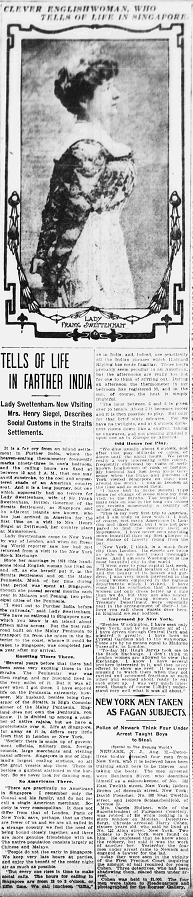

Enhanced reading here


Sunday, March 30, 2014

Wives in the shadow (1). The Lady of the Lake.

This will be the first in a new series of posts about some of the women who were connected to the administrators or other prominent men instrumental in the running of the British Empire. Often, these men remain famous and are still commemorated in statues, geographical features, books, etc. or remembered in other ways, but the women in their lives are for the most part shadowy figures and all but forgotten.

The Lady of the Lake (Lady Swettenham #1). 

Sydney Lake, Kuala Lumpur

Port Swettenham was a name familiar to me as a child from several pages in my father’s stamp collection headed “Straits Settlements”. In what is now Malaysia, the port is now Port Klang but it was originally named after the first Resident-General and later Governor of the Straits Settlement, Sir Frank Athelstane Swettenham, a man said to rank in importance in the region with Sir Stamford Raffles, the founder of Singapore.  Frank’s brother, Sir James Alexander Swettenham, also had links to the region.

In May 1938, divorce on the grounds of incurable insanity was allowed for the first time in the British court system. One of the first petitions brought was by Sir Frank Swettenham against his wife Lady Constance Sydney Swettenham. Frank had married her sixty years earlier in 1878 when she was only 19, a daughter of Cecil Frederick Holmes, housemaster at Harrow School. The Oxford Dictionary of National Biography gives only a little information about her:
Her inherited tendency towards manic depression was exacerbated by Swettenham's treatment of her; the marriage blighted his personal life for sixty years

and
In 1894 Swettenham's wife returned to Perak from the most serious of several mental breakdowns, pregnant by another man. Swettenham dispatched her in semi-public ignominy to Britain, where her son was described as stillborn. Swettenham's own personal life was far from blameless; a misdemeanour formed the basis for blackmail, to which he was subjected from about 1890 until his retirement in 1904.
While Swettenham certainly was a highly accomplished administrator on behalf of the Empire, he clearly wasn’t good husband material, or he simply chose the wrong woman. Was Sydney (she seems to have preferred this name to Constance) already on the edge when she married Frank and what exactly was it in his treatment of her that tipped her over? What were the real circumstances of her pregnancy? Without knowing Sydney’s side of the story and only that of Sir Frank on the record, it has to remain conjecture.

The imperious man of empire as seen
 by John Singer Sargent
Frank first tried to rid himself of Sydney in England in 1904, bringing a petition for divorce and accusing her of adultery with a man called Ernest Henry Mander. The paperwork for this divorce petition has just recently been released under the 100 year rule and makes for interesting reading. 

The judge believed Sydney when she said she wanted a reconciliation with her husband and so he threw out Frank’s petition. This indicates that the judge considered the adultery charges to be false, and it tends to raise more questions as to other motives behind Frank wanting a divorce. It seems that Sydney was abandoned to her own devices for months and years at a time, yet Frank still expected her to undertake wifely imperial duties as and when he insisted on them. As the ODNB is so vague on the circumstances of Sydney’s pregnancy and stillborn child, it seems rather too convenient that the baby didn’t survive and it could be there was a cover-up to avoid further embarrassment. Perhaps he did survive and was quietly set up for private adoption as was often the case with upper class “mistakes” during this era.

Whatever the real facts, poor Sydney Swettenham seems to have had a blighted life at the hands of an overbearing and arrogant husband who was rather typical of such men of his time, but she continued to insist she was sane when the second divorce petition was brought in May, 1938. 

In June 1939, Sir Frank, then aged almost 90, married his long-time live-in lover (Lady Swettenham #2). Sydney died a year after Frank, in 1947.

Malaysian playwright and actor Sabera Shaik was intrigued by this sad story and recently wrote and acted in a play called Lady Swettenham about Sydney that has been presented in India and a number of other Asian countries.

This only accessible photo is alleged to be Constance Sidney [sic]  (unable to confirm as Harrow Photos website currently unavailable) but from the feathers in her hair this suggests this would have been her in debutante dress rather than her wedding.

Copyright ? Harrow Photos

The old Port Swettenham has long gone from the map, but at least some small vestige of Sydney lives on in Kuala Lumpur, the capital of Malaysia, and Sydney Lake is the centrepiece of the Lake Gardens.


Several images of Sir Frank taken by Gertrude Bell can be found at the Newcastle University Library


Tuesday, February 18, 2014

Link to the Pistol Packin' Empress

As this lady certainly didn't carry buckets and was more more likely to put them on the heads of serfs and use them for target practice, read all about the Empress Anne Ivanova on my other blog Digging the Dust.


Empress Anna


Friday, January 17, 2014

More sinned against than sinning

A recent visit to the Cascades Female Factory in Hobart, Tasmania, was a most moving experience for me. Being the sole female in the audience of an interactive guided tour that tells the story of a young woman convict, I felt the full force of it. The two actors were excellent, and the booming wrath of the male overseer really put the fear into me and gave me an inkling of the terror and helplessness the poor women incarcerated in this dreadful place would have experienced.

From the memorial to the women who passed through Cascades


One aspect that particularly made me shudder was being sent to the solitary or dark cells. Without any light source and measuring about a yard wide and two yards long, just enough room to stand up and lie down in, a woman could be locked up in here for weeks or months for all kinds of reasons, including having had a baby out of wedlock, even if she had been a victim of rape or abuse at the hands of an overseer or employer to whom she had been assigned. It would have taken a woman of extraordinary mental resilience and courage to have survived such an experience and not emerge from the darkness totally insane. Yet some remarkable women did recover, went on to lead normal lives after they earned their freedom and become the founding mothers of a nation.


Remains of the cells.  Read more here

But what is also disturbing is that this appalling treatment of women wasn’t confined to just the faraway convict colonies of Australia in the late 18th and early 19th centuries. Despite growing enlightenment over prison reforms, dark cells were still being constructed in British prisons. Here is a map dated 1875 from the Northumberland Archives of a proposed female dark cell to be built at Morpeth Gaol (now converted to luxury apartments). As of writing this, I don’t know if this cell was ever completed and used, but sincerely hope that it wasn’t and possibly someone reading this might be able to tell me more.


Copyright Northumberland Archives. Click here for larger version.


Morpeth Gaol today


Wednesday, November 27, 2013

"Fastest woman on earth"

While researching an article for my other other blog Digging the Dust on dangerous hair accessories for automobiling females, I came across this Wikipedia entry for Dorothy Levitt, described as the “fastest woman on earth”.

And here is yet another ground-breaking woman of whom I knew nothing previously and despite quite a few links on that Wikipedia page it seems she has not yet warranted a full biography.

A couple of years ago, the documentary Penelope Keith and the Fast Lady was made by BBC4 but it doesn’t seem to have had world-wide distribution as I certainly would have watched if I had ever known about it.

Dorothy seems to have made her name mostly with automobiles, but hidden away among reports about her is the fact that she set the world’s first water speed record. Various American newspapers reported on her enthusiastically, as in this article from the Los Angeles Herald of January 6 1907 in which she lays down the gauntlet to American women to challenge her. (To read the full enlarged text, follow this Chronicling America link.)


And this other one from The Minneapolis Journal of 25 November, 1906, that features her water speed record as well. (Again, read the enlarged text in full at Chronicling America.)

Also note the bizarre torpedo-like invention down in the right hand corner to make women swim faster!


Rather than repeat what many other bloggers have already written about Dorothy Levitt, here are several links that will tell you more:


Rootschat (her genealogy)


A reprint of Dorothy’s book The Woman and the Car


Sunday, November 3, 2013

Christine Granville ... "nothing remotely civil"

As a follow-up to my earlier posts on little-known women who have won the George Medal, I have just read the story of another more famous recipient of this award, Christine Granville, born Krystyna Skarbek, the subject of the recent book by Clare Mulley entitled The Spy Who Loved. 

I was astonished to learn that Christine had originally been recommended for the George Cross but was "downgraded" to a George Medal and that even that didn't come easily. I quote the following passage from Clare Mulley's book which demonstrates the attitudes Christine was up against in spite of her incredible bravery that was equal to that of any man:

"Christine's courage and achievements throughout her service were admired by everyone who knew her. In December 1944, General Stawell had recommended her for the George Cross, the civil equivalent to the Victoria Cross, for her 'nerve, coolness and devotion to duty, and high courage'. But Christine was not impressed. The only medal that she would be proud to wear she told Francis [Cammaerts] would be a military medal. It was 'typical' of her, he said, that this was the one honour she could not hope to get.'  Women were ineligible for British military honours, a situation that caused another female agent, Pearl Witherington, to protest that 'there was nothing remotely civil' about what they had done. For reasons not recorded, General Alexander, the Supreme Allied Commander of the Mediterranean Theatre, then downgraded Stawell's recommendation for Christine to an OBE. This was subsequently raised to a George Medal by the War Office to 'make it obvious that she had been decorated for gallantry, as her courage was outstanding'."

The Spy who Loved

My own review of the book can be read on my other blog Regina the Bookspinner here.


Sunday, October 27, 2013

Female maestros - a passing "novelty"?

After writing about three women who received public accolades for their physical bravery, I now return to what this blog was originally intended to be about: women who have made their mark in some way in spite of the obstacles in their paths.

While they may not be literally hauling buckets any more, women are still battling through fields that are predominantly male preserves. There was considerable dismay in Australia recently after its voters threw out their first female prime minister and replaced her with a conservative regime that has only one woman on its front bench. Even the opposition has reverted to jobs for the boys.

That led me to thinking about another area in which women seem to still be poorly represented – despite it being in the usual female-friendly area of music and the arts – and that is conducting orchestras.

It doesn't take long to find plenty of articles online bemoaning the lack of female conductors of major orchestras, not helped by recent sexist and fatuous remarks by Vassily Petrenko as to why there are so few. His comments drew a great deal of flak with even demands that he resign as conductor of the Oslo Philharmonic. Read them here and here.

But it is difficult to find any authoritative information on who really was the very first woman to lead a prestigious orchestra with both a national and international reputation.

As far as USA goes, one suggestion is that she was Mary Davenport Engberg, who warrants a pathetic six-line Wikipedia entry although this link to a Washington State history site gives a few more details about her.

Antonia Brico (1902-1989)

A better candidate is Antonia Brico, who conducted the New York Philharmonic in 1930 and also guest conducted at the Berlin Philarmonic. More on her in this Encylopaedia Britannica entry, but this sentence neatly sums up what the bosses of big orchestras really thought about female conductors back then and perhaps the same attitude still lingers today.

"After the mid-1940s, perhaps as her [Brico’s] novelty disappeared, she found it increasingly difficult to gain serious attention in the traditionally male field she had chosen, her manifest ability notwithstanding."

In the UK, Iris Margaret Lemare is acknowledged as the first professional British woman conductor and a tireless supporter of the music of British composers yet she doesn’t seem to warrant a Wikipedia entry although she has an extensive entry in the Oxford Dictionary of Biography. Her obituary here.

Dame Ethel Smyth was perhaps better-known as a composer and also gained more notoriety as a sufragette and associate of the Bloomsbury Set later in life, but in 1928 she was reputedly the first woman to conduct the Berlin Philarmonic.

Veronika Dudarova (1916-2009)

Russia has had women conductors for a long time and the most famous and enduring was probably Veronika Dudarova. 

Teresa Carreno from Venezuela (she said she was a grand-niece of Simon Bolivar) was another early woman conductor. 

The newspaper archives carry reports on many women conductors of small, private or localised orchestras in the early part of the last century, including mention of one Australian, Marguerite Edwards, who allegedly became the first woman conductor in South Africa in the early 1900s but on whom I can find no further information.

Then there is Contessa Anne McParland Filippini that various sources credit with being the first acknowledged Australian female conductor yet she has no specific web link and few other references other than being notable as ancestor of her infinitely better-known grandson, musician Paul Kelly. It is strange that neither she nor her husband Count Ercole Filippini and the orchestra that they founded have been recorded in the Australian Dictionary of Biography or similar sources. A short book was published about her in 1988 but is obviously long out of print.

As to the first mention of any woman conducting music, this cryptic sentence appears in Samuel Pepys’ diary of 6 June 1661.

" ... we went and eat and drank and heard musique at the Globe, and saw the simple motion that is there of a woman with a rod in her hand keeping time to the musique while it plays, which is simple, methinks."

Was she really conducting the “musique” as in a band or orchestra, or was she just some woman tapping time to the tune, or was it some kind of automaton or clockwork figure, as seems most likely and suggested by the comments to be read on the Pepys site.

If anyone reading this can provide more information on early female orchestra conductors I would be most interested in hearing about them.


Simone Young in action. Copyright Sahlan Hayes, The Age


A number of woman conductors present and past from around the world can be found from this link. Once you start looking for them, their range of nationalities, capabilities and accomplishments are truly amazing, so there is great hope for the future of female conducting ... if they can only manage to break through the glass ceiling!

Here are just a few:

Tomoni Mishimoto from Japan has conducted the Bolshoi Orchestra.
Alondra de la Parra is from Mexico and a noted rising star.
Australian Simone Young was the first woman to crack the all-male Vienna Philharmonic.
Marin Alsop is American and conducts both the Baltimore and Sao Paulo Symphony Orchestras and in 2013 became the first woman to conduct the Last Night of the Proms in London.
Another highly respected American conductor is Jo Ann Falletta.
Xian Zhang is Chinese-American and conducts the Milan Symphony and has also appeared at the Proms.
Sarah Ioannides is another true international of Greek parentage, born in Canberra Australia, raised in the UK and has conducted at Carnegie Hall.
Diane Wittry is another American conductor with an amazing CV and who has written books of instruction on conducting.

Iona Brown (1941-2004)
Iona Brown was primarily associated with chamber orchestras, but also conducted many famous symphony orchestras including the London Philharmonic, Royal Liverpool Philharmonic, Hallé, Bournemouth Symphony, Danish Philharmonic, San Francisco Symphony, and Tokyo Philharmonic.
Ruth Gipps (1921-1999) was a composer well-known for inspiring music in young people but allegedly lost out as conductor of the City of Birmingham Symphony due to sexist prejudice of the time.


This is a  great photo of Sarah Ioannides from her web gallery

Copyright Sarah Ioannides