Sunday, May 12, 2019

Bravery at Sea. Stewardess Kate Gilmour


There’s been recent discussion in the media about the appalling behaviour of passengers in air crashes, some of them holding up swift escape because they insist on retrieving their carry-on luggage. Why, when your very life is on the line, would you worry about your stuff?

On the positive side, all credit must go to those cabin crew who have to handle such situations without “losing it” themselves. While some individuals behave in strange and irrational ways in life and death situations, others manage to rise to the best they can be.

This is the first in a series of posts about women who have remained cool in crisis situations - especially forgotten heroines of the sea - and whose stories have slipped out of history. Most don’t even warrant a Wikipedia entry so often there is no definite starting point for research into them other than a few lines in the newspaper archives.

Stewardess Kate Gilmour was the first ever female recipient of the Lloyd’s Medal for Saving Life at Sea in an incident sometimes known as Malta’s Titanic, the disastrous end to the SS Sardinia. (The best website giving comprehensive details of this tragedy is that of The Malta Independent - click here to read in full.)

Sample of the medal from the National Maritime Museum

Born in Edinburgh around 1861, nothing can be found on Kate’s early life but by her thirties she was single and living in Liverpool. As she may have always been away from the country at the times of the Census Returns, only one that can be confirmed is that from 1891, when a Kate [Gilmore], occupation “Seas Stewardess”, was a boarder with the Murray family at 34 Samuel Street, Liverpool.


She appears in a number of Crew Lists as Stewardess, and among the vessels she served on were SS Rameses, SS Cretic and SS Orotova, not always giving the same age, however, and she seems to have stayed 38 for quite a number of years! Her address in England was always the same, i.e. 128 Belmont Road, Liverpool.


Khedivial Mail Line, SS Rameses at Malta

Kate was the sole female member of the crew of the Ellerman and Papayanni Line SS Sardinia when it set sail from Liverpool in November 1908 with 25 first class, 6 second class passengers and general cargo, bound for Mediterranean and Middle Eastern ports. Twelve of the original passengers were still on board when the vessel left Malta for Alexandria in Egypt and Jeddah, the port for Mecca. In Malta, the number of passengers increased to around 200, consisting of a large group of Arabs on pilgrimage. Without cabins, they simply pitched tents on the upper deck for shelter during the short passage.

About one mile out of Grand Harbour, Malta, at 11 am on  25 November 1908, the steamer caught fire in the forward hold - it was believed to have originated in a quantity of naphtha but the inquiry found that it may have been through the carelessness of the pilgrims.

The fire was witnessed from Malta and all kinds of rescue vessels set out, but the fierce wind blowing made it difficult to assist. Captain Charles Littler did everything he could to save his ship but he had to abandon the wheel and the vessel circled helplessly close to the shore. Then came repeated explosions with dense smoke and flames 200 feet high. Hatches blew off, killing all in the vicinity. All in the engine room were trapped and perished. Eventually the ship foundered on the Riscasoli Rocks.

General panic ensued. Some individuals including a number of crew members, immediately jumped overboard, while others remained and strove heroically to try and save the ship and its passengers in an orderly fashion with the use of lifebelts. 

One of these was Kate Gilmour who kept her nerve and did everything she could to ensure that the passengers - women and children in particular - were safely off before leaving the  ship herself.

A survivor wrote:
“We left Liverpool with a full cargo of machinery and Manchester goods for Alexandria. Our bunkers had been supplied with enough coal at Liverpool to last us until our return to Malta.The Sardinia left Malta at 9.45 this morning.We had just got outside the harbour, and the crew were engaged in securing the port anchors, when suddenly a cry of ‘Fire’ was heard and fumes were seen to issue from a ventilator on the port side. A hose was promptly turned on and a stream of water was poured down the ventilator. This, however, did no good, as in a few minutes flames started out of the other ventilators and in less than 10 minutes the whole vessel amidships was enveloped in flames. The Arab passengers - 140 Moorish pilgrims, going to Mecca –were told to leave the hatch, to which they clung desperately, but they declined to move. All of those who remained forward perished, except some of those who jumped overboard”.

Copyright


So near yet so far ... the rescue in progress
The final death toll was two European passengers - one of them being Douglas, four-year-old child of James Gordon and Jessie Grant - 16 crew members - including the Captain, First Mate, R. Frew, Chief Engineer, J. Niel, and 2nd Engineer D. Hislop, and more than 100 Arab passengers - although only 23 bodies were ever recovered. All the Arab pilgrims that were found were buried in the Turkish cemetery on Malta.


British and international newspapers carried the story - this from the Aberdeen Press and Journal
SARDINIA SURVIVORS
AFFECTING SCENE ON ARRIVAL
How Young Grant was Lost
The remains of Captain Littler of the Ellerman Liner, Sardinia, destroyed by fire at Malta were to-day taken from the Venetian at Liverpool and removed to Birkenhead for the funeral tomorrow.
Survivors of the crew with the exception of five still in hospital at Malta, also returned by the Venetian, and affecting scenes were witnessed on the quayside.
Survivors, who had evidently been cautioned not to make statements, refused to say anything when questioned about the disaster. They were escorted to cabs and rapidly driven away with friends.
Miss Kate Gilmour, stewardess of the Sardinia, who remained on the Venetian, spoke feelingly of the loss of Mr and Mrs Grant’s little boy. He was a great favourite on board, she said, passengers calling him the fourth mate. A brave effort to save him was made by the second officer, who strapped the lad on his back and jumped into the sea, but the boy was washed away.


A month later, the newspaper reported: -


THE SARDINIA DISASTER
LLOYD’S MEDAL FOR A STEWARDESS

 The Committee of Lloyd’s have decided to bestow the silver medal of the society upon Miss Kate Gilmour, stewardess of the steamer Sardinia, which was destroyed by fire off Malta on November 25, as honorary acknowledgement of her extraordinary exertions in contributing saving life that Miss Gilmour, her coolness and courageous conduct greatly contributed to saving many lives, as she remained aboard encouraging panic-stricken Arabs to avail themselves of the only means of escape, and it was not till the women and children were rescued that she was persuaded to board a boat.
This is the first occasion which Lloyd’s medal for saving life at sea has been bestowed upon a woman.

And in July of the following year: -


INVESTITURE AT BUCKINGHAM PALACE

The King [Edward VII] held an investiture at Buckingham Palace yesterday, at which he personally bestowed the insignia of various honours conferred on the occasion of His Majesty’s birthday. Subsequently His Majesty received a number of men, a boy, and a lady, and bestowed upon them awards for gallantry in saving or attempting to save life by land and sea. Miss Kate Gilmour received a silver medal for gallantry on the occasion of the burning of the Sardinia in Malta Harbour. Miss Gilmour who is the first lady thus decorated, was stewardess of the Sardinia and was almost the last to leave the ship after being instrumental in saving many lives by her coolness and courage.

After being awarded the Medal, Kate promptly disappears from the records and she does not appear to have continued with her career as ship’s stewardess.

What happened to her? Did she emigrate? Did she marry? Or did she simply change her name in order to escape her brief moments of fame? 

Research is ongoing. If anyone reading this knows anything else about Kate Gilmour, please do contact me.

 
The story of the brave stewardess Kate Gilmour was told many years later in the Melbourne Argus 3 September 1936

Friday, January 25, 2019

Matthew and Ann, a love story


The recent announcement of the discovery of the grave of Captain Matthew Flinders (1774-1814) during the excavations at Euston Station brings to mind the romantic and poignant love story of him and his wife, Ann Chappelle, from whom he was separated for most of their married life. (There is also some irony that the archaeological skills used to find and identify his body will owe much to the methodology established by Flinders’ famous grandson, the archaeologist William Flinders Petrie.)


Ann Flinders (right) with her half-sister Isabella Tyler (left)
standing is her daughter Anne (later Petrie)
(Copyright unknown)

Ann Chappelle was a little older than Matthew, being born on 21 November 1772. Her father John Chappelle had been a merchant navy captain who died of illness in the Dutch East Indies in 1776 and as a result Ann had been reluctant to tie herself to another mariner. But her love for Matthew won out and they were married by Ann's step-father, the Rev. Wiliam Tyler in St Nicholas Church at Partney, Lincolnshire, on 17 April 1801. Just three months later Matthew sailed on HMS Investigator to commence his famous circumnavigation of Australia.


Extract from Parish Records for St Nicholas Church, Partney, Lincs.

Matthew had wanted Ann to sail with him and brought her onto the ship but the Admiralty was furious and wouldn’t permit her to remain on board. She would not see her husband again for nine years, for six of which he was held prisoner of the French in Mauritius.

He returned to England in 1810 and they lived in a number of rented houses in London while he prepared his Voyage to Terra Australis for publication, and their only child, Anne, was born in 1812 (baptised St. Giles, Middlesex, on 1st April), when her mother was forty years old.

The Design & Art Australia website states that Ann was apparently blind in one eye “by lancing due to smallpox” but she had “above average mental powers, considered clever, with a sweet and perfect temper, beloved by all who knew her, witty, generous, nervous, with aptitudes for poetry, literature, singing, verse, and painting flowers from nature”. The DAAO also mentions that her watercolours of flowers have been shown in exhibitions, although none of these appear to be available on the internet.

Matthew named Mount Chappell/Chappelle in Bass Strait after Ann.


After Matthew’s death, Ann lived on for almost another forty years and would have seen many changes in that time. When she died in February 1852, the once remote continent of Australia was booming with an influx of settlers and gold-seekers. Her husband Matthew’s charts of the route around the coast continued to be used until well into the 20th Century.

There is a box of sentimental mementoes belonging to Ann in the State Library of New South Wales. It contains locks of hair from family members and pressed flowers from their grave sites.

State Library of New South Wales

Discover more about the romantic love story between Ann Chappelle and Matthew Flinders in the historical novel My Love Must Wait by Ernestine Hill and Letters to Ann by Catherine Retter and Shirley Sinclair.


Wednesday, December 12, 2018

Inspiration for "Brave New World"?


As this blog has a focus on historical women who have not been properly acknowledged for their achievements or contributions, this recent article from The Guardian captured my interest:-
 "A forgotten feminist dystopian novel, a story of eugenics and newspaper manipulation that is believed to have influenced Brave New World and Nineteen Eighty-Four, is coming back into print for the first time in a century, complete with pages that were suppressed in 1918." (Read article in full here.)
Rose Macaulay may not be as well-known today as she once was, and her arcane writing style can be dense and difficult for modern readers.

Still, if her themes did influence some of the most famous dystopian novels written by men, then it is good to know that she is now being given her due.

The Towers of Trebizond is considered her masterpiece but I have lost count of the number of times I have picked it up and then persevered to a certain point where it defeats me because I have lost patience with its privileged characters and/or their religious arguments. Clearly, I’m too much of a philistine to truly appreciate Macaulay - and thus hover around a B- in her A to C Ministry of Brains - but many others do appreciate and enjoy her work.

The new version of What Not has now been published by Handheld Press.


Wednesday, November 28, 2018

A family connection to "The Lady in White"


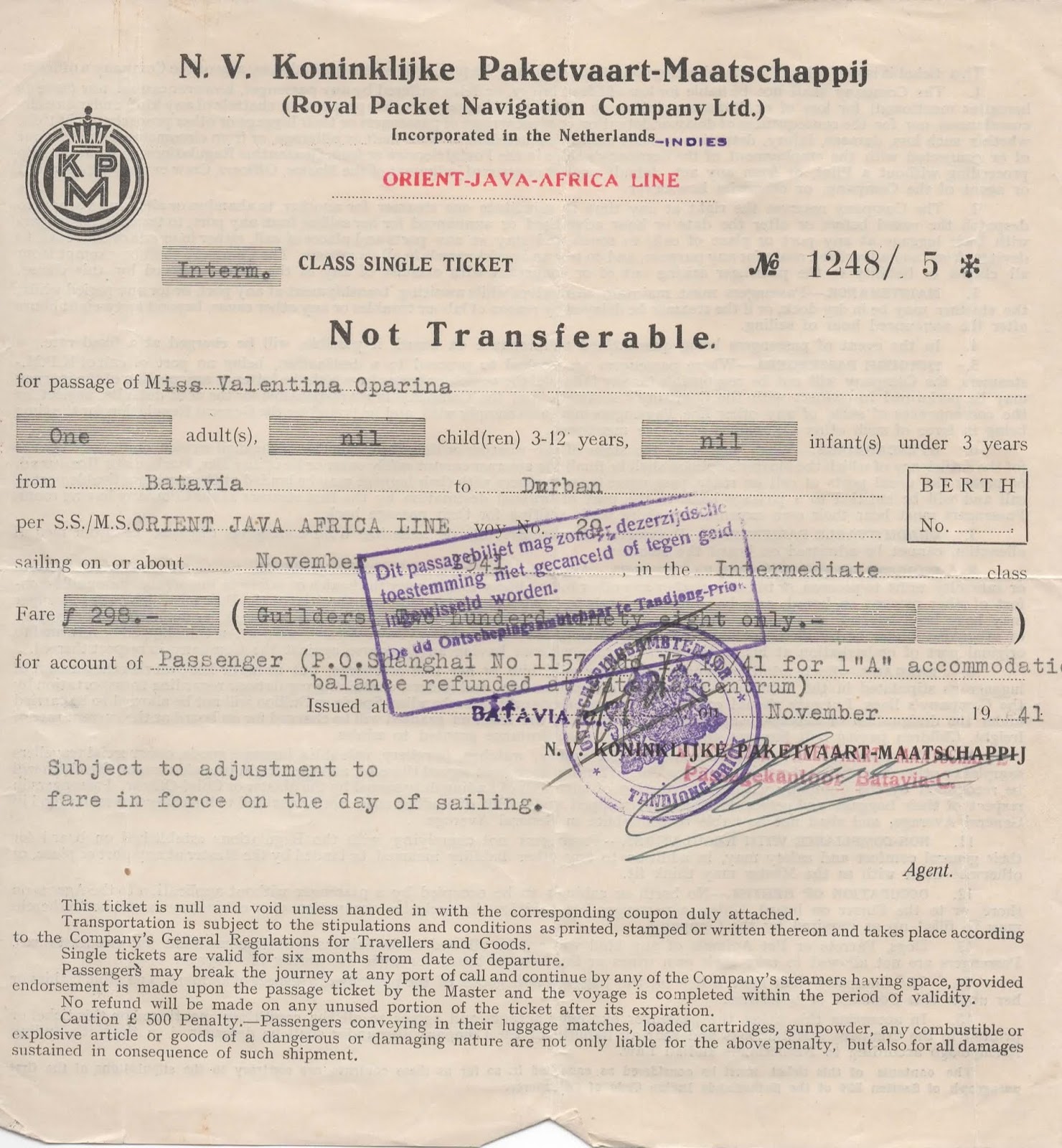
A few days after the Japanese attacked Pearl Harbor in December, 1941, my mother sailed into Durban on SS Tegelberg, a Dutch vessel that had left Batavia [now Jakarta] on 15th November. She had transferred there from another vessel, SS Tjisadane, which had sailed from Shanghai on 17th October, one of the last passenger ships to escape the Chinese city before the Japanese took control. 

It was a bold risk she was taking; leaving behind her family and all she knew, travelling across a dangerous war-time ocean to a foreign country to marry a man she had not seen for some years. 


First voyage on SS Tjisadane


SS Tjisadane


Passage ticket for second part of journey Batavia-Durban 1941


SS Tegelberg

As my mother sailed into Durban, she would have been thrilled  - and relieved no doubt - to see her future husband waiting for her on the wharf. One wonders what she would have made of the woman who was also there singing her heart out with the aid of a megaphone.

The story of Perla Siedle Gibson will be well-known to South Africans and many servicemen and merchant navy personnel who served during World War II and transited the port of Durban. 


All images Vintage News Stories (link below)

She was born Perla Marie Siedle in Durban in 1888, the daughter of Otto Siedle, originally a London watchmaker turned prominent businessman and shipowner. Her mother Mary served for a time as Deputy Mayor of Durban. Perla had two brothers, Karl and Jack. Karl died in World War I but Jack Siedle became a famous cricketer.

Perla had a voice with a register somewhere between soprano and contralto. She had studied singing in Europe, but did not follow a professional career for long as she married and raised a family in South Africa.

It is said that when World War II was intensifying, she had seen off a young Irish friend at the harbour and as the ship pulled away from the quay, the young man shouted down to Perla to sing “something Irish”. She immediately burst into “When Irish Eyes are Smiling” and it was a big hit with the departing sailors. After that, she made up her mind to greet and farewell all ships that entered Durban Harbour for the duration of the war.


She could see the daily shipping movements from her house on a hill, and she’d jump in her car and drive down to the docks. She always wore the same costume - a white dress, red hat and necklace. Her distinctive (and ample!) figure could be spied from a long way off and she became known as “The Lady in White”.

Between April 1940 and August 1945, it has been estimated she sang to more than 5,000 merchant and navy ships and more than 250,000 servicemen. She even sang her husband (Clement Walter “Jack” Gibson) and two sons and daughter off on war service. When she received a telegram to say that her son, 2nd Lt. Clement Roy Gibson had been killed at Anzio in March 1944, even though her heart must have been breaking, that didn’t stop her and she continued singing to the ships.


Post-war - two very different "Forces Sweethearts" - Perla and Vera Lynn

There don’t appear to be recordings or films of Perla’s singing available on the internet, and I wonder what she sang that day as the SS Tegelberg arrived bringing my mother to her new life? Sarie Marais? Auld Lang Syne? Land of Hope & Glory? Maybe all of them, and more. 

Ironically, I made a similar reverse journey to that of my mother when I sailed out of Durban 30 years later also to start life in  a new country with a new husband. There was no operatic send off by that time. Perla had in fact died just a few months previously in 1971.

Statue to Perla at Durban, unveiled by Queen Elizabeth II in 1995
Now removed to the Durban Maritime Museum 

Perla had written an autobiography, and there are a number of articles and blog posts about her online. 

With many thanks to major source: Vintage News Stories - The Lady In White


Sunday, July 8, 2018

Hush WAACS - Secret service women in the family tree


Since the lifting of the official secrets embargo on the history of code-breaking during World War II, there have been numerous books written about Bletchley Park, plus a number of documentaries, TV series and films, many of them about female code-breakers.

What is much less known is that women were also involved in a similar service during World War I. They were called the “Hush WAACS” but the information on them is rather scanty. Rather than describe here what they did in too much detail, see this link:-

GCHQ page on the Hush Waacs 


Imagine my surprise and delight, then,  while doing family research I would discover that two of the 17 only known Hush WAACS were distant cousins of my late husband and they came from the same area of Tyneside that features strongly in both our family trees.

WAACS off to help with the war effort

The two women were sisters, Violet Munby (1884-1974) and Gladys May Munby (1887-1955). Neither sister ever married. 

Their names appear on this list Hush WAAC Roll of Honour as follows, showing the dates they were associated with the intelligence services in WW1.

Name: Gladys Mary [sic] Munby
Age in 1918: 30
Arrived I(e)C: October 1917
Departed: November 1918
Notes: Pianist educated in Germany; YMCA work before 1917
Name: Violet Munby
Age in 1918: 33
Arrived I(e)C: March 1918
Departed: November 1918
WAACS off duty in France
Their parents were John William Munby (1855-1946) and Anne Bates Walker (1849-1915). John William Munby was a prominent figure in North Shields/Tynemouth area.


Anne Bates Walker's mother, also Anne Bates (1816-1853), was the sister of my husband’s great-great-grandfather, Matthew William Bates (1820-1860). (See below for the story of how she died and also an uncanny link to my own ancestors.)

The Munby family lived at 16 Northumberland Square, North Shields, considered to be a quality address described as “the closest thing on Tyneside to the iconic Georgian squares of Edinburgh, Dublin, London and Bath.” Sadly, No. 16 has only just been demolished in 2017 - read here.


Northumberland Square, c. 1960s

There are many references to J.W. Munby and his services to the community in the local newspapers from 1904 when he first stood for council, culminating in him becoming Mayor of Tynemouth in 1923, although he appears to have kept working in various capacities until he died aged 90 in 1946.


North Shields store owned by the father of Gladys and Violet Munby


Family vault of Annie Bates and J W Munby, Preston Cemetery, North Shields


The two sisters clearly received fine educations, being fluent in languages and talented musicians. There are a number of newspaper references to both of them being awarded prizes for their piano playing. 

Gladys studied musicianship in Germany and returned to England at the outbreak of World War I. She advertised lessons in the local Tyneside newspapers and after the war was over, appeared to do a fair bit of travelling. She made the news columns when she arrived in Sydney, Australia, in 1923. This from the Sydney Morning Herald of  29 December 1923:

LAST NEW ARRIVAL OF 1923
Miss Gladys Munby arrived in Sydney during the week as the last English musician to put in an appearance during 1923. 
This young artist was trained at the Dresden Conservatorium as a pianist under Miss Rappoldi, a venerable virtuoso who studied under Liszt, and also with Emit Kronke, a pupil of Grieg, with whose works he is much identified. 
After 18 months at Dresden the war broke out, and Miss Munby beat a hasty retreat to her home in Newcastle-on-Tyne, where she studied with Mr. E.L. Bainton, and took her A.R.C.M. [Associate of Royal College of Music] by examination. 
Her musical career was then submerged by the calls of her country. She first went to Etaples, the great reinforcement base for the British army, and did canteen work with the Y.M.C.A [Young Men's Christian Association] until the authorites were apprised of her fluency in speaking German. Miss Munby at once joined the Q.M.A.A.C. (Queen Mary Army Auxiliary Corps), and was attached to the Intelligence Department at St. Omer to decode German wireless.This department was colloquially designated the "Hush Waacs". 
After the Armistice the pianist was transferred to the British Army of Occupation on the Rhine and was employed in the Censor's Office to read Germany correspondence. 
Miss Munby then left on a visit to friends in New Zealand and now proposes settling in Sydney, where her knowledge of music and languages should be of the utmost service to her.

Gladys was appointed Music Teacher at the prestigious Sydney Presbyterian Ladies College and in 1926 was transferred to the new PLC in Orange, New South Wales - that school is now known as Kinross-Wollaroi.


She continued to pop up in Australian news reports over several years, with descriptions of her playing at recitals in places like Gunning and Goulburn, New South Wales, and she is even listed in programs for Sunday night concerts on Radio 2BL in Sydney.


The last we hear of Gladys in Australia is this report from Sydney Sun 16 March 1930:


Gladys Munby 
Further study on the Continent is the mission of Miss Gladys Munby, who is leaving immediately for Paris and Vienna. 
For the past six years Miss Munby has successfully taught pianoforte playing and music in leading schools of Sydney and country districts, and she has much excellent work to her credit, her students having given proof of this by results at examinations .... 
... Miss Munby is an associate of the Royal College of Music, London, and she has already had four years' study with eminent masters at Dresden and elsewhere on the Continent.

So where did Gladys go after that? Did she really do further study in Europe as stated in the article? Although she popped up on Australian Electoral Rolls during her stay in that country, there is no sign of her in the English ones. 

Nothing else can be found for her until the 1939 Register in which she is listed as a School Teacher living at a boarding hotel in Montague Street adjacent to the British Museum.


In the 1939 Register next to her entry there is handwriting - "QM[sic]MAC Administration Temporary Unit". This suggests her previous war experience with the Queen Mary Army Auxiliary Corps may have come to the notice of someone. Did she then go to Bletchley Park or somewhere similar to do translation or other covert work?


Gladys died in 1955 in a nursing home in Cinderford, Gloucestershire, which is a long way from her family connections in North Shields. She left an estate valued at £14,000 (at least £300,000 today) and her executors were her half-brother Robert Pickering Munby and sister Violet Munby. 


Meanwhile, Violet Munby had a similar background to Gladys, with a few newspaper reports of her piano playing locally on Tyneside, but she is even more mysterious. 


The passenger ship records show that after World War I, Violet travelled back and forth across the Atlantic between the UK, France, Italy and New York regularly. Her occupations are as numerous as the  crossings she made. She's a "maid", or "journalist", "housekeeper" or "housewife", "companion" or "governess", even a "proof-reader". Her addresses on arrival are rarely the same either and they 
included flats in Kensington and Hampstead in London as well as 317 West 45th Street, New York, an apartment complex originally built by Vincent Astor. Others are just shown as Washington DC, or random places such Birmingham or Crookham in the UK. 


By 1955, she gave the address of her brother, Dr. William Maxwell Munby, who lived at 12 Mill Grove, Tynemouth. There is also only one passenger list showing her sister Gladys heading for New York to stay at the W. 45th Street address. 


Violet also acquired an American Social Security Number, likely to have been issued in New York some time after 1936 and before 1951. 


Name:Violet Munby
SSN:050-22-3716
Last Residence:
800 (U.S. Consulate) London, United Kingdom
BORN:25 Apr 1884
Died:Dec 1974
State (Year) SSN issued:New York (Before 1951)

What was she doing going back and forth so frequently and doing different, rather humble, jobs? Could she have been some kind of courier? 


The most telling evidence that Violet may have been involved in some sort of covert travel is this extract from 1943 of a rare Pan American Airways manifest of people flying from Darrell Island, Bermuda, to New York. 


Violet is accompanied by another woman and both are described as "Civil Servants" with their Bermuda address as "Imperial Censorship Bermuda".


So this proves that during World War II Violet continued to be involved in similar work to that she did in World War I. 

Most of the censors were women, called Examiners or "Censorettes", with the majority being older spinsters chosen for their world knowledge and language skills ... one wonders if Gladys might also have been there? Other censors included:


... a Swiss florist, the former manager of the Anglo-Czechoslovakian Bank of London and a Cambridge University professor with a command of 30 languages including rare Indian dialects.
Others who have worked for the Imperial Censorship in Bermuda are Val Gielgud, a BBC producer, Eric Maschwitz, author of Balalaika, a doctor who was at Dunkirk, a biographer of obscure French philosophers and a Scottish girl with a command of 10 languages. Age was no issue with several eminent language scholars over the age of 80.

Read more here
Censorship Department in Bermuda
Bermuda's Espionage Role
The Man Called Intrepid - the "boss" at Bermuda


It may well be that Violet even crossed paths with Elizebeth Friedman, recently the subject of a fascinating book  by Joseph Fagone entitled The Woman Who Smashed Codes  - read my book review here.


Princess Hotel, Bermuda, HQ of the WW2 Censorship Department


Violet died in North Shields in 1974, her last address being the same as that of her brother, William Maxwell Munby. Her estate was just over £53,000 [around £600,000 today], so either she came into family money from her father or she earned a very good income doing whatever it was she did.

From what I have discovered about these two spinster sisters, it may be that there is a book waiting to be written on them!


My research into Gladys and Violet is ongoing as there is probably much more to be found on them in the archives of the intelligence services but which are not easily accessible to hobbyists like me and it will require the skills and contacts of an investigative journalist to really find out what the pair of them were up to. 


---oOo---

As to the family connection:

The mother of Anne Bates Munby, Anne Bates Walker,  ran a shop selling flour at 154 Buckingham Street, Newcastle upon Tyne, where she was blown up in a gas explosion in 1853 when her daughter was only about 4 years of age. 


The inquest found that Anne's husband William Walker was to blame as he obviously wasn't very smart, having gone looking for a gas leak with a lighted candle! 

Anne’s brother, Matthew William Bates, my husband’s ancestor, rushed to her aid but she died soon afterwards. 


By a truly bizarre coincidence, my own g-g-grandmother Julia Atkin (1803-1861) lived just a few doors away from that very shop around this period and no doubt she may have known Anne Bates Walker or even bought supplies from her. She may even have been a witness to the explosion.

See this relevant page of the 1851 Census. Little Anne Bates Walker on the first line, my own g-g-grandmother [sic. Judith Aikin] fourth from the bottom.


One final twist in this uncanny tale of family connection is that Violet appears to have lived out her later years with her brother, Dr. William Maxwell Munby, at 12 Mill Grove, Tynemouth.

In the early 1960s when I was a teenager, and many years before I met my husband or had the slightest inkling we had ancestors who'd once lived close to one another, I'd just started my first job in Newcastle on Tyne during which time I lived briefly in a rented house in Tynemouth with my parents prior to us moving to Canada to live. 


I can't now recall the exact number, but the house was a corner one in Mill Grove, possibly quite close to, maybe even right across the road, from the Munbys.