Friday, February 18, 2022

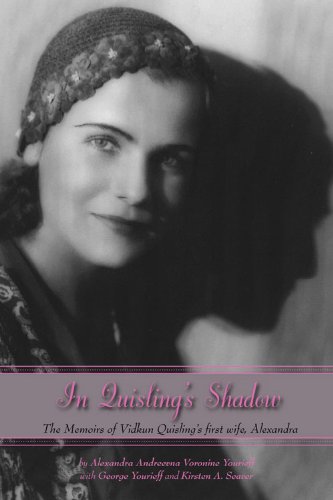
"In Quisling's Shadow. The Memoirs of Vidkun Quisling's first wife, Alexandra" (Book Review)


This is not a new book, being published in 2007, but I was interested in it as part of some genealogical research I’m doing and it has relevance to this blog as its subject was certainly a woman forced to carry a history bucket. It also has contemporary relevance in light of the current frictions between Ukraine and Russia reflecting a resurgence of old feuds.


In 1921, Alexandra Andreyevna Voronina lived in the city of Kharkov in the Ukraine with her mother. Once a very wealthy family, they had fallen on the hardest of times. Her father disappeared years earlier and it was never known whether he had deliberately abandoned them or was the victim of sinister action (common enough in the Bolshevik era). Not only had the region suffered the after-effects of the Russian Revolution and the ensuing Civil War, it was also devastated by an epic famine in which some starving individuals had resorted to cannibalisation to survive (there are verified images of this in the book).

Originally training to be a ballet dancer, Alexandra had to compromise her dreams and do whatever work she could. She found it in the office established by the Norwegian explorer and humanitarian, Fridtjof Nansen, from where famine relief was co-ordinated. Nansen’s representative in Ukraine was Captain Vidkun Quisling. Alexandra fell completely under his spell and, although barely seventeen years of age, married him.

There follows a lengthy, and often depressing, litany of what today would be classified as spousal abuse – not physical, but definitely mental. Quisling, who has left a highly controversial mark on history being the man who led Norway and sided with Hitler during World War II and for which he was later executed, was controlling, cold and calculating, probably psychotic. He manipulated Alexandra into an abortion and then forced her to accept - and even share a bedroom with - the new woman in his life, another Russian, Maria Vasilyevna Pasetchnikov.


A forcibly staged photograph of
the  two "wives"
on the balcony of the Quisling apartment


Maria, in turn, was a nasty character who may have been an agent sent to spy on Quisling and the Norwegian relief effort and she added further layers of scheming and subterfuge to the cruel treatment of Alexandra.

Back and forth across Europe, Alexandra was often left to fend for herself in places where she knew no-one, then with little warning, was drawn back into Quisling’s net, then abandoned again. In spite of promises that he’d keep her safe and secure as long as she lived, he was erratic with money. In spite of all that he did to her, Alexandra still hoped that Maria would be sent packing, that she and Quisling would get back together again.

My main quibble with her story is that some areas are overly detailed while others are glossed over and leave more questions. Alexandra often complained about being isolated for weeks or months in places, or left destitute without any means of support. She said she survived solely on a diet of bananas and cream for months on end - curious foods that may not have been as cheap as the poor person’s diet of bread and dripping (or the French equivalent). With Quisling being so mean in providing her with a regular income and unable to work, she must have had some regular source of money other than just help from generous friends. She would certainly have needed funds when travelling around Europe plus undertaking artistic and ballet studies in France and eventually being able to buy her passage to Shanghai. The latter part of her life in Shanghai and later in California includes two further marriages and a child, but this is all rushed through. The fact her mother was abandoned on her own in the Crimea for the rest of her life is also troubling and it would have been interesting to find out what efforts, if any, had been made to get her out

Alexandra seemed overly naïve, compliant and trusting. From our more liberated distance of a century later, it can be hard to understand why she did not stand up to her treatment and find a way of being self-sufficient. But one has to remember the attitude of the times and the fact she was still in her teens, subservient to her husband’s whims and not financially independent. Her story has its sad echoes today with still far too many women at the mercy of unscrupulous and controlling men.

Three stars.

Print copies may be hard to find, Kindle versions available from:

amazon.com


Tuesday, February 15, 2022

The Ladies of the Committee - (1) Millicent Garrett Fawcett


Formidable. Frosty. Forthright. Just a few of the words that have been applied to Millicent Garrett Fawcett by her biographers and those who knew her. Even at this distance in time, and although being physically tiny in stature, she looms large among the campaigning feminists of the late 19th and early 20th Centuries.


Mrs Fawcett, 1890
Photograph by W. and D. Downey
National Portrait Gallery UK


Whether she was the best choice to head the Ladies Committee to investigate the concentration camps in South Africa is debatable, especially in the middle of a war in which opinions were sharply divided. Millicent was a dyed-in-the-wool Imperialist with little tolerance of anyone with opposing views. Like many of that era, she believed Britain had a right to rule the world. It would not go well for any of her fellow Committee members who questioned that idea.


In her memoir, "What I Remember", Millicent recalled it was in July 1901 that she received a visit from Edith Lyttleton, the wife of the sportsman/politician Alfred Lyttleton, asking her if she would be prepared to travel at short notice to South Africa to inspect the state of the camps there. Edith had became a founding member of the Empire friendship organisation, the Victoria League.
 

Millicent commented that Alfred "was admired, beloved and trusted by all parties and all sections of the country as few men have ever been" - rare praise for a politician - and he was most concerned about what was happening to the children in particular in the camps.
 

Edith informed Millicent that she would be joined by other women who were experts in health and child welfare. Millicent didn't hesitate but, when discussing her duties with the Secretary of War, St John Brodrick, she was vehement that she would not speak to Emily Hobhouse at all.


Emily Hobhouse
angloboerwar.com


While it is understandable that Millicent might prefer to see things for herself, she was already biased against Emily. Apparently the knives had been out previously between the two women over another matter when Emily supported some tenants in a building owned by the Fawcett family.
 

Added to this, although it was Emily’s exposure of what was happening in the camps that initiated the Committee, she had suffered from bad press, with words like "excitability" and "hysterical" attached to her, compared to Millicent's personality with its cool detachment and control.


Emily's behaviour suggested she was more sympathetic to the Boer cause than she should have been, and she had been deported from the Cape for her activities. No wonder Millicent would have nothing to do with her.


Millicent left England on 22 July 1901, accompanied by Lady Alice Knox, wife of General Sir William Knox then on service in South Africa and Miss Lucy Deane, a trained Inspector of Factories and an expert in infant welfare. Also on the voyage were Millicent's daughter Philippa, Lucy Deane's sister and Lady Alice's maid. The three other ladies to make up the Committee were already in South Africa.


While on board ship, the women made plans and also learned from a fellow passenger a few words of the Cape Dutch Taal, although one can't imagine Millicent being that keen on learning what many English people disparagingly considered a pidgin or inferior language to the true Dutch of the Netherlands.


When they arrived at Cape Town, the ladies were accommodated in the grand Mount Nelson Hotel before meeting up with the two female doctors, Ella Scarlett and Jane Waterston and the nurse, Katherine Brereton. Millicent's memoir described the violent, hostile factions that were evident in the city and the many other charitable and relief committees who had differing viewpoints as to what needed to be done in the camps. There were many "cooks" stirring the broth and the ladies were discouraged from calling at Government House in case of trouble.


Mount Nelson Hotel
Still one of the world's grandest hotels


Emily Hobhouse had done much of her travel and investigation of the camps on her own, paying her own way, struggling with red tape permission, using primitive modes of transport and often going without food, water or a bath or shelter. She had experienced the deprivations of war at first-hand and wasn't impressed to learn that the Ladies Committee undertook their travels in a special train supplied by the Cape Government. Millicent described this as follows:

"Each of us had what was a second-class compartment fitted with sleeping accommodation. There was a large saloon for our meals, with a travelling kitchen attached, and we also had a Portuguese cook named Gomez, and the services of a young Tommy named Collins, lent to us by General Knox, Lady Knox’s husband. We looked all round the arrangements made for our comfort and security with interest, curiosity, and gratitude, for these railway carriages were to be our home for about five months."


(Details of the progress can be followed through Millicent's memoir that is available online, see Chapter XVII. More of it will feature in further posts on this topic.)


More biographical background on Millicent:-

Millicent Garrett Fawcett was born in Suffolk in 1847, one of eleven children of a wealthy industrialist Newson Garrett who encouraged his children in liberalism, to be outgoing and have enquiring minds. Millicent developed a passion for self-education, literature, the arts and there’s no doubt her elder sister, Elizabeth Garret Anderson, who would become Britain’s first female doctor, was a major influence on her.
 

At eighteen, she met the blind Cambridge professor and Reformist, Henry Fawcett, 14 years her senior, and they married in 1867. Her only child, Philippa, destined to be a prominent mathematician, was born a year later. They were a radical couple for the time and their successful partnership was strengthened by shared interests in outdoor pursuits, women’s education and suffrage.


Henry and Millicent by
Ford Madox Brown, 1872
National Portrait Gallery UK


Millicent developed her own writing and speaking career, specialising in politics and economics as well as women’s issues. It was rare for a woman to give a speech in public and, as still happens today, she had her critics than she must be neglecting her child while involved in such work.


When Henry died suddenly in 1884, Millicent was bereft and she and Philippa moved in with another sister Agnes Garrett, who was a pioneering businesswoman in her own right, but she continued on the same path. She became the leading force in women’s suffrage and a frequent lecturer at girls’ schools and women colleges.


She also espoused many other causes including moral rearmament and backed campaigns connected to prostitution and the sexual exploitation of women and children, but her puritanism and inflexible attitude towards private morality were often at odds with her support for public reforms. She was appalled by the idea of free love out of marriage, yet ahead of her time in advocating divorce by consent.


The rest of Millicent’s life as regards her activities during World War I and the advancement of women has been well-documented. She was bestowed with many honorary doctorates, and received a Damehood in 1925. She died in 1929.


Some of her liberal Victorian attitudes may seem at odds with her feminism and modern women will find her a challenge to evaluate. This closing paragraph from her entry in the Oxford Dictionary of National Biography seems to summarise her well.

"In contrast to the Pankhursts, she shrank from hero-worshippers and did not seek to be a charismatic leader. As a speaker she was persuasive rather than inspirational; she was not a good committee chairman. Victorian values lingered on in her sexual, social, and imperial politics. She took pride in her ‘Englishness’ and—not only in the context of war—had some of the defects that implies. Her statesmanlike qualities were nevertheless crucial in guiding the British women's movement. The range of her contributions to public and intellectual life in an exceptionally long and influential career has only recently been recognized. Once stereotyped as a narrowly bourgeois liberal feminist, she is now appreciated as a woman who also addressed the exploitation of working women and child abuse. She argued—while never adopting the language of ‘sex war’—for votes for women on the grounds that they had distinctive insights to offer and interests to defend. Changing fashions and values in politics and feminism, and her status as an emblem of the women's movement, have complicated the task of her biographers—and will continue to do so until it becomes possible to represent eminent feminists sympathetically as creatures of, as well as rebels against, their times."


Millicent Fawcett, c. 1910
Photograph by Olive Edis
National Portrait Gallery UK


Introduction to the Ladies

Millicent Garrett Fawcett

Lucy Deane Streatfeild

Katherine Blanche Brereton

Lady Alice Knox

Dr Jane Waterston

Dr Ella Scarlett Synge


Personal library sources include:

"The Concentration Camps of the Anglo-Boer War, A Social History" by Elizabeth Van Heyningen

"Rebel English Woman, The Remarkable Life of Emily Hobhouse" by Elsabe Brits

"The Compassionate Englishwoman" by Robert Eales

"The Boer War" by Thomas Pakenham

"Those Bloody Women, Three Heroines of the Boer War" by Brian Roberts


Sunday, February 13, 2022

The Ladies of the Committee (Introduction)

Women were actively agitating for the vote and equal or greater representation in many areas of British life when an all-female Committee was appointed to investigate the concentration camps created during the Anglo-Boer War (1899-1902) in South Africa. 

This new series of posts will look at the women who were part of that group. *

The leader, Millicent Garrett Fawcett, is perhaps the most famous. In 2018, she became the first woman to be commemorated with a statue in Parliament Square in London, unveiled by then Prime Minister, Theresa May.

Perhaps less well-known are the other members. They were Lucy Deane, Lady Alice Knox, Dr Jane Waterson, Dr Ella Scarlett and Katherine Brereton.

Emily Hobhouse brought the appalling conditions in the camps to wider knowledge in Britain and the world at large. Her explosive revelations caused outrage in the general public and embarrassment to the UK Government. **

Like Emily, the members of the Committee were progressive women in that era of struggle for feminist representation and advancement, but they weren't all compatible in their beliefs and ideals so the dynamic would have been an interesting one and Emily herself was not included or consulted.

All of them hailed from the respectable upper classes but if one bases success, achievement and historical recognition as being given the accolade of an entry in the Oxford Dictionary of National Biography, only three of them - Fawcett, Deane and Waterston – are included in the ODNB. 


(Image source unknown)


Although often called the Fawcett Commission or Ladies Commission, it was not a Royal Commission in the true sense.

**  See my two previous posts about teachers for the camps and a book about Emily Hobhouse.


Saturday, November 13, 2021

What's in a name? (Or a bit of fake news)

I’ve been researching and writing about lesser-known individuals and unusual or obscure historical events for quite a few years now and one thing I learned early on is never to fully trust sites like Wikipedia or other secondary sources that often copy or cut-and-paste wrong information ad infinitum.

Also, one has to be careful drawing direct attention to errors with certain historical societies and interest groups as they often don’t like anyone meddling with things taken as gospel and will stubbornly stick to old incorrect facts even if new evidence shows otherwise.

And, of course, one has to be careful with archival newspapers as they are just as bad as our modern ones with sensationalist reporting, blind copying of errors and outright “fake news”.

This leads me to an example that seems to be fixed as fact when it comes to the origins of a name of a place in Australia.

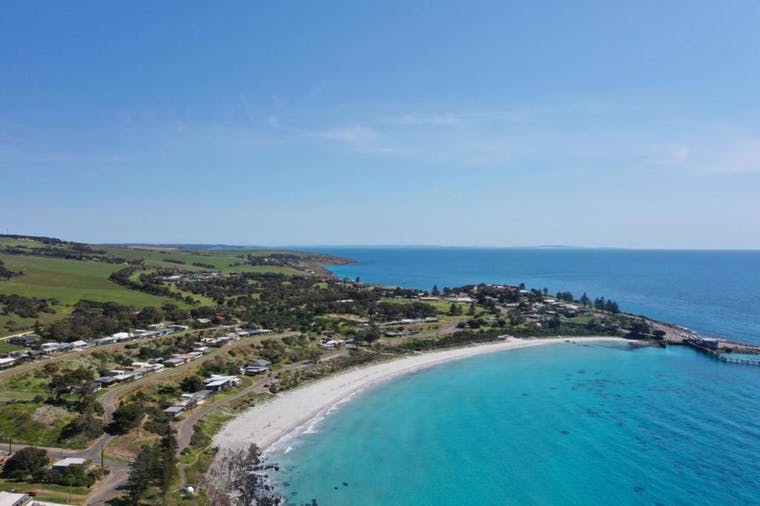
Penneshaw is a community of around 300 permanent residents on Kangaroo Island, South Australia. 


Penneshaw and its beach


According to numerous sources, the name came about when the Governor of South Australia, William Francis Drummond Jervois [pronounced “Jarvis”], renamed the town of Hog Bay. He served as Governor from 1877 to 1882 and named or renamed a few places in his time. It’s understandable if the Colony was hoping to attract new residents to Kangaroo Island that Hog Bay might not sound like the most appealing address.

Wikipedia states the town’s origin is as follows:-

“Penneshaw was named after a combination of the names of Dr. F.W. Pennefather, private secretary to Governor Jervois, and Flora Louisa Shaw, The Times colonial editor, a visitor to Government House.”

I stumbled upon this information while researching the life and times of the fascinating Flora Louise Shaw and was immediately sceptical.


Flora Shaw, c. early 1890s


The story certainly goes back to early 20th Century as it is mentioned in this 1908 article in the Evening Journal of Adelaide on the Nomenclature of South Australia, suggesting it rests with someone called E.H. Hallack who wrote about early Kangaroo Island. This “contributed” story from the Kangaroo Island Courier in 1935 reinforces the idea:

How Penneshaw Was Named

(CONTRIBUTED)

Penneshaw is a double barrelled name (Penne-shaw). Penneshaw was named after Miss Flora Shaw, now Lady Lugard, she married Lord Lugard a distinguished Governor of British colonies at Nigeria in Africa and elsewhere. Miss Shaw married Lord Lugard in 1902. Before her marriage Miss Shaw was for several years a member of the staff of The Times, a London newspaper. She became head of its Colonial Department, where her work was to collect news of Britain beyond the seas.

The Times sent Miss Shaw to Australia and New Zealand to study on the spot the problems of those far away countries. She came to Adelaide and stayed at Government House, and her abilities impressed the Governor and all who met her. At that time the Governor’s private secretary was Mr William Pennefather, later he became Professor Pennefather at the Adelaide University.

During Miss Shaw’s stay in Adelaide the Governor had to name a town situated on Kangaroo Island. By combining the names of Mr Pennefather and Miss Shaw, His Excellency made Penneshaw.


Just before Jervois was reassigned to be Governor of New Zealand, the first announcement of Penneshaw appears when blocks of land were being offered for sale. The first notice was published in the Adelaide Evening Journal on 13 January 1882. (See also South Australian Government Gazette.)

Frederick W. Pennefather can be traced through the records. He was a barrister-at-law and aged 28, and is shown on a passenger list from London into Williamstown, near Melbourne, arriving on 3 July 1881 in the clipper ship “Superb”. He was appointed Private Secretary to Jervois on 28 November 1881, see Adelaide Observer.

I haven’t investigated how Pennefather was appointed to the position, but it was most likely through connections with persons of high standing in the colonial service, both in England and Australia. He would later become a QC and lecturer in law at Adelaide University.

So, sometime between his appointment in late November 1881 and the gazetted announcement of the sale of land at Penneshaw in early 1882, the decision to give him half of the name was made. It seems Governor Jervois had named a few places in South Australia after people who worked for him (e.g. as in this A-Z of South Australia’s towns)

One has to ask what was the reasoning for splitting the name between two individuals and how is it even remotely possible that the “Shaw” half came from Flora Louise Shaw who was nowhere near Australia in the early 1880s.

Born in England in 1852, Flora was one of fourteen children of an Army Major. In her twenties she was already a published author of children’s books but she had not yet embarked on her extraordinary journalism career that would eventually see her become the Colonial Editor of The Times of London.

Like many women of that era, it was quite acceptable for her to write children’s literature under her own female name but she was not expected to take on serious journalism. When she did begin writing articles for newspapers in the mid-1880s, she used the name of “F. Shaw”, and would later be known as “The Thunderer”. It was not until after she had written some amazing reports that her true identity became more widely known and she was grudgingly acknowledged by male editors.

But back in 1881, she was not yet 30 and living a somewhat impoverished existence as a housekeeper or nurse companion with her income supplemented by her writing. She also did charity work with the poor in the slums of London. Flora had been forced to leave home after clashes with her father’s new wife. As she struggled to support herself, she lived in a rented room in a small village in Surrey.

The furthest she had been abroad in the early 1880s was to family in France. The likelihood of her making the expensive, long and often arduous voyage to Australia and visiting Jervois in Adelaide is highly improbable. Nothing in the summary of her life in the Oxford Dictionary of National Biography, or the latest biography which is based on her own letters, diaries and other academic sources suggests she made such a journey around that time.

Flora Shaw did not have a formal education, but from a young age was fortunate in having mentors like John Ruskin, Thomas Carlyle and George Meredith to encourage her in spite of her sex. She certainly would count governors, diplomats and politicians among her friends and acquaintances, but all of this came much later in life when she was well-established. At the age of 50 she married Lord Lugard, who would become Nigeria’s first Governor General and who was also the Governor of Hong Kong.

So, is there a chance she was a good friend of Jervois or his family? I can find nothing to connect them, apart from the Royal Military Academy at Woolwich where Flora sometimes did use the library when a girl and where Jervois had trained as a young man, but whether their paths had ever crossed and Jervois was so impressed by her that he kept her in mind for some naming acknowledgement seems doubtful. 

Then there is the romantic angle. Could Flora have had some connection to F. W. Pennefather as they were about the same age, both with Irish family origins? Did they know each other and could he have been one of her many spurned younger suitors and he suggested to Jervois the combined name? It is possible, but how to prove is another matter!

It was in 1892-93 that she travelled to South Africa and then Australia for the first time and officially as a correspondent, very likely visiting Government House in Adelaide, but this was over 10 years after Penneshaw came into existence and a different Governor was in office. 

I then wondered if the “Shaw” part of the town’s name could be attributed to someone else entirely and it didn’t take long to discover another man called James Shaw.

He was a building contractor who helped to develop South Australia. He was instrumental in the construction of many of Adelaide’s fine public buildings during the time of Governor Jervois, and also the new Government House. Active in community service, he was an Alderman and would eventually be a Mayor of Adelaide. Surely this would have qualified him for some sort of acknowledgement? Even today, his track record would make far more sense than naming part of a remote town after a fiction author and budding female journalist, as Flora Shaw still was in 1881.

Somewhere along the line, the story behind the naming of Penneshaw got twisted or someone (possibly E.H. Hallack) decided it sounded better to have the name of a successful and charismatic woman included in the town’s name, rather than just another pompous official or business figure.

If anyone can disprove the story about the naming of Penneshaw and/or provide me with evidence that Flora Shaw was beyond doubt the recipient of this honour, then please do contact me!

This extensive document detailing the origin of South Australian place names repeats the usual legend although it does mention that someone thought it was to honour Alfred Shaw, a local physician, so that shows some people weren’t so sure about the Flora Shaw connection.

And when it comes to naming places, Flora Shaw is allegedly the first person to give Nigeria its name and although this is based on an article written by her in 1897, some researchers are now starting to question it - so possibly a whole other story about fake news!

Flora was an avid believer in populating the Empire with poor or disadvantaged English people but this cartoon from Punch suggests that Australia wasn't too keen on the idea!

Miss Australia to Miss Shaw -"Thank you so much, my dear, for all the nice things you've said about me. But - don't send out the invitations until I am quite ready to 'receive'.


Sunday, May 16, 2021

"The most merit of any woman in England"

It's been a while since I posted here. When I first started writing this blog way back in 2009, there were still not that many sites devoted to women missing from the history books; the forgotten or little-known, and the completely unheralded women who did something remarkable in their own way but were always forced to walk in the shadow of men. 

I am glad to say that since then a plethora of information is now available as other researchers rediscover their stories and share them with others, although there are always going to be more and some women will forever be elusive depending on when or where they lived or what paltry records of their lives were left behind.

Just this week, I read this interesting blog by June Watson on Northumberland Archives about Emma, Lady Tankerville, who deserves to be better-known for her scientific mind as well as her exquisite botanical drawings. 


The only available portrait of Emma. See Wikipedia

Admittedly she was an aristocrat with important connections and not many ordinary mothers with a big family would have the resources to find the time to indulge in her interests. Sir Joseph Banks was a good friend and, according to the blog ..."Banks personally named a new Chinese swamp-orchid in honour of Emma, the Phaius tankervilleae. Emma was recorded as the first person to successfully cultivate the orchid after its introduction to England in 1778."

For anyone living in the area, the Northumberland Archives advises that a display of Emma's work from her time on the island of Madeira will be exhibited 18-26 September 2021 at Alnwick Garden in collaboration with the Royal Botanic Gardens, Kew.


The first orchid cultivated in England. See Wikipedia


Thursday, September 10, 2020

"Epiphany in the Snows" - the lost altarpiece


This small print card in the collection of Tansley & Co, Vintage Merchants of Maldon, is signed by the artist and it may well be a scarce surviving copy of an original painting that no longer exists.


Entitled “Epiphany in the Snow”, it is an unusual variation on the Nativity tale showing Mary, Joseph, and baby Jesus being visited by the Three Wise Men who have travelled far, but with reindeer, malamutes or huskies rather than on the more familiar camels.

The Star of Bethlehem hovers over the Christ Child and Mary, both of whom are dressed in ermine and wear moccasins on their feet. On their left is a man dressed as a Royal Canadian Mounted policeman, who may represent a protective Joseph. The kneeling visitor is an Inuit offering valuable walrus tusks. A Cree man holds a beaver and the crouching Hudson’s Bay Company man has a white fur in his lap, probably Arctic fox. All of these represent gifts of Canada’s wealth in a bygone age.

But the artist, Violet Teague, was an Australian, so how did she come to paint this unusual Christmas scene? And what happened to the original?

Violet was born in Melbourne in 1872 to an English doctor and his Canadian wife. Well-educated at home and at a prestigious girls’ school, she travelled widely studying art in England and Europe.

She was versatile and made woodcuts, painted portraits and both sea and landscapes, as well as writing poetry and illustrating books. She won medals for her work in places as diverse as San Francisco, Paris and London. Later in her career, she turned to religious subjects, doing altarpieces, two of her better-known Australian ones were for the Kinglake St Peter's Memorial Church and St James the Less at Mt. Eliza. For the Kinglake Church, she replaced the Nativity shepherds with Australian Lighthorsemen.

She was commissioned in 1938 to do the altarpiece for the new All Saints “Arctic” Cathedral in the remote settlement of Aklavik in the North West Territories of Canada. “Epiphany in the Snow/s” was put on show in Melbourne before being sent to be exhibited in London and then shipped to Canada where it was ceremoniously set in place by the Canadian Governor-General in 1939. (Image shows how it was placed.)


Sadly, on Palm Sunday 1974 [some sources say 1972], the Arctic Cathedral burned down. Despite much searching, I have been unable to confirm beyond all doubt that the altarpiece was lost at the time, but it is highly likely. The Cathedral was not rebuilt and most of the residents of Aklavik eventually relocated to the larger settlement of Inuvik. (Image below prior to the 1970s fire)


Fortunately, Violet’s other altarpiece called “Adoration of the Shepherds” in the Kinglake Church did not suffer the same fate in the 2009 devastating bush fires, as the congregation had wisely relocated it a few years earlier to St Paul’s Cathedral in Melbourne and replaced it with a copy, which was destroyed along with that church. (Image shows the interior prior to the 2009 bush fire.)


Violet died in 1951, but her altarpiece at Mt Eliza is still intact (image below) and her other work occasionally appears in art sales or auctions or can be seen in institutions around Australia.


This is the concluding extract from the Australian Dictionary of Biography and sums up Violet’s appearance and lively character:
Less than five feet (152 cm) tall, with grey-blue eyes and masses of light brown hair, Teague was …. 'a small frail person … quiet of manner, yet with a surprising vitality and a more surprising sense of whimsy … she comes out direct in a mannered way and her eyes twinkle humorously'. She 'can talk on any subject from racehorses to the decline of Western Culture exactly and wittily'.
Violet’s more detailed biography can be read here.


Some links to her art work

NG New South Wales

NG Victoria

Short film by NGA Director Betty Churcher on Violet and her friend Jessie Traill

City of Melbourne


Other Information

Thursday, June 11, 2020

Burning Questions


All this current hysteria involving the vandalising and demolishing statues of historic  individuals in various countries because of a tragic, nasty event in America that some consider to be the direct legacy of racism and slavery is worrying to all with a passion for history.  *

There is a desperate need to stop judging our ancestors through modern eyes and to recognise the past is a different country that can never be changed, but must be acknowledged. We all have ancestors who were slaves in some form - serfs, peasants, indentured labourers - as well as more privileged others such as farmers, landholders and merchants who owned or controlled them. 

Removing offending images from sight and memory will never solve current problems. If anything, people should have reminders of the wrongs of the past in order to strive for right in the present. 

History abounds with conundrums of moral conscience. A century from now, the principles and truths we hold dear may shock and horrify our descendants and memorials to our current heroes could cause some new and as yet unimagined offence. 

Thinking of examples of other distasteful monuments, I am reminded of a visit some years ago to St Nicholas Buccleuch Church in Dalkeith, Scotland, when I stood in front of an ornate and impressive wall-mounted edifice to a minister of the church that was erected by his family in his memory. The flowery Latin description indicated that he had been a venerated individual; a loved father and respected pastor of his parish for more than twenty years from the mid 17th Century.

But when I read the leaflet provided about the Church, I was horrified. Reverend William Calderwood was revered because he personally undertook the investigation, torture and condemnation of 60 local women for witchcraft and who were subsequently burned at the stake.

During his tenure as minister, trials were held weekly at Dalkeith and his partner in this "witch-pricking" was the local headmaster: two educated men from whom one would have expected enlightenment but instead they were involved in this most macabre and cruel practice. 

In his life and times, Calderwood was considered a good man for doggedly searching out what he thought were the bad elements in his society, the "Devil's spawn", and doing away with them. For this, he received the esteem of his community much as we give out medals and awards today.


(This image comes from the church leaflet and it is difficult to find any others online, my personal photos being too dark to reproduce. Perhaps being well aware of the unpleasant history behind the Calderwood memorial, the church's governing body prefers it remains low-key.)

So - if one believes that monuments celebrating historic individuals who did offensive, cruel or wicked things should be desecrated or removed from public sight, then every single statue, effigy and plaque in every historic setting needs to be examined. Who is going to decide what goes and what does not? It is a ludicrous idea not far removed from book-burning and destruction of archives undertaken by many dictatorships. 


Edinburgh Witch Burning
Germany Book Burning


There are no images of Calderwood himself to be found, but it also worth noting that the paranoia against witches in Scotland was initiated at the highest level by King James VI (later to be King James I of England).  It was he who gave free rein to men like William Calderwood, encouraging them to do their best in ridding his country of witches.

King James VI (James I) can be seen in several places - there are effigies at the Bodleian Library in Oxford and at Trinity College, Cambridge, as well as in the grounds of Glamis Castle, childhood home of the late Queen Mother.

It is doubtful anyone is going to deface or pull them down anytime soon because of the hundreds of innocent women and men who died horrific deaths as a result of his own phobia.


King James VI of Scotland and I of England
Glamis Castle, Scotland


Witches Well Memorial -
site where witches were executed outside
Edinburgh Castle, Scotland
(Atlas Obscura)

The Daemonolgie, written by King James VI/James I.

Map of Scotland showing where witches were tried and/or executed. Lists 45 names in Dalkeith alone and includes a number of men.

Database of nearly 4,000 individuals in Scotland accused of witchcraft.


* It is often overlooked that many African slaves sent to the Americas were the victims of their own race when warring or rival tribes captured them and transported them for sale to the Europeans at the coast. The Arabs perpetuated this shocking trade until well into the 20th Century (see my earlier blog on the home for slaves in Cairo.)