Sunday, February 13, 2022

The Ladies of the Committee (Introduction)

Women were actively agitating for the vote and equal or greater representation in many areas of British life when an all-female Committee was appointed to investigate the concentration camps created during the Anglo-Boer War (1899-1902) in South Africa. 

This new series of posts will look at the women who were part of that group. *

The leader, Millicent Garrett Fawcett, is perhaps the most famous. In 2018, she became the first woman to be commemorated with a statue in Parliament Square in London, unveiled by then Prime Minister, Theresa May.

Perhaps less well-known are the other members. They were Lucy Deane, Lady Alice Knox, Dr Jane Waterson, Dr Ella Scarlett and Katherine Brereton.

Emily Hobhouse brought the appalling conditions in the camps to wider knowledge in Britain and the world at large. Her explosive revelations caused outrage in the general public and embarrassment to the UK Government. **

Like Emily, the members of the Committee were progressive women in that era of struggle for feminist representation and advancement, but they weren't all compatible in their beliefs and ideals so the dynamic would have been an interesting one and Emily herself was not included or consulted.

All of them hailed from the respectable upper classes but if one bases success, achievement and historical recognition as being given the accolade of an entry in the Oxford Dictionary of National Biography, only three of them - Fawcett, Deane and Waterston – are included in the ODNB. 


(Image source unknown)


* Although often called the Fawcett Commission or Ladies Commission, it was not a Royal Commission in the true sense.

**  See my two previous posts about teachers for the camps and a book about Emily Hobhouse.


Saturday, November 13, 2021

What's in a name? (Or a bit of fake news)

I’ve been researching and writing about lesser-known individuals and unusual or obscure historical events for quite a few years now and one thing I learned early on is never to fully trust sites like Wikipedia or other secondary sources that often copy or cut-and-paste wrong information ad infinitum.

Also, one has to be careful drawing direct attention to errors with certain historical societies and interest groups as they often don’t like anyone meddling with things taken as gospel and will stubbornly stick to old incorrect facts even if new evidence shows otherwise.

And, of course, one has to be careful with archival newspapers as they are just as bad as our modern ones with sensationalist reporting, blind copying of errors and outright “fake news”.

This leads me to an example that seems to be fixed as fact when it comes to the origins of a name of a place in Australia.

Penneshaw is a community of around 300 permanent residents on Kangaroo Island, South Australia. 
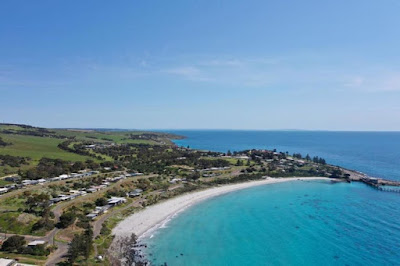

Penneshaw and its beach


According to numerous sources, the name came about when the Governor of South Australia, William Francis Drummond Jervois [pronounced “Jarvis”], renamed the town of Hog Bay. He served as Governor from 1877 to 1882 and named or renamed a few places in his time. It’s understandable if the Colony was hoping to attract new residents to Kangaroo Island that Hog Bay might not sound like the most appealing address.

Wikipedia states the town’s origin is as follows:-

“Penneshaw was named after a combination of the names of Dr. F.W. Pennefather, private secretary to Governor Jervois, and Flora Louisa Shaw, The Times colonial editor, a visitor to Government House.”

I stumbled upon this information while researching the life and times of the fascinating Flora Louise Shaw and was immediately sceptical.


Flora Shaw, c. early 1890s


The story certainly goes back to early 20th Century as it is mentioned in this 1908 article in the Evening Journal of Adelaide on the Nomenclature of South Australia, suggesting it rests with someone called E.H. Hallack who wrote about early Kangaroo Island. This “contributed” story from the Kangaroo Island Courier in 1935 reinforces the idea:

How Penneshaw Was Named

(CONTRIBUTED)

Penneshaw is a double barrelled name (Penne-shaw). Penneshaw was named after Miss Flora Shaw, now Lady Lugard, she married Lord Lugard a distinguished Governor of British colonies at Nigeria in Africa and elsewhere. Miss Shaw married Lord Lugard in 1902. Before her marriage Miss Shaw was for several years a member of the staff of The Times, a London newspaper. She became head of its Colonial Department, where her work was to collect news of Britain beyond the seas.

The Times sent Miss Shaw to Australia and New Zealand to study on the spot the problems of those far away countries. She came to Adelaide and stayed at Government House, and her abilities impressed the Governor and all who met her. At that time the Governor’s private secretary was Mr William Pennefather, later he became Professor Pennefather at the Adelaide University.

During Miss Shaw’s stay in Adelaide the Governor had to name a town situated on Kangaroo Island. By combining the names of Mr Pennefather and Miss Shaw, His Excellency made Penneshaw.


Just before Jervois was reassigned to be Governor of New Zealand, the first announcement of Penneshaw appears when blocks of land were being offered for sale. The first notice was published in the Adelaide Evening Journal on 13 January 1882. (See also South Australian Government Gazette.)

Frederick W. Pennefather can be traced through the records. He was a barrister-at-law and aged 28, and is shown on a passenger list from London into Williamstown, near Melbourne, arriving on 3 July 1881 in the clipper ship “Superb”. He was appointed Private Secretary to Jervois on 28 November 1881, see Adelaide Observer.

I haven’t investigated how Pennefather was appointed to the position, but it was most likely through connections with persons of high standing in the colonial service, both in England and Australia. He would later become a QC and lecturer in law at Adelaide University.

So, sometime between his appointment in late November 1881 and the gazetted announcement of the sale of land at Penneshaw in early 1882, the decision to give him half of the name was made. It seems Governor Jervois had named a few places in South Australia after people who worked for him (e.g. as in this A-Z of South Australia’s towns)

One has to ask what was the reasoning for splitting the name between two individuals and how is it even remotely possible that the “Shaw” half came from Flora Louise Shaw who was nowhere near Australia in the early 1880s.

Born in England in 1852, Flora was one of fourteen children of an Army Major. In her twenties she was already a published author of children’s books but she had not yet embarked on her extraordinary journalism career that would eventually see her become the Colonial Editor of The Times of London.

Like many women of that era, it was quite acceptable for her to write children’s literature under her own female name but she was not expected to take on serious journalism. When she did begin writing articles for newspapers in the mid-1880s, she used the name of “F. Shaw”, and would later be known as “The Thunderer”. It was not until after she had written some amazing reports that her true identity became more widely known and she was grudgingly acknowledged by male editors.

But back in 1881, she was not yet 30 and living a somewhat impoverished existence as a housekeeper or nurse companion with her income supplemented by her writing. She also did charity work with the poor in the slums of London. Flora had been forced to leave home after clashes with her father’s new wife. As she struggled to support herself, she lived in a rented room in a small village in Surrey.

The furthest she had been abroad in the early 1880s was to family in France. The likelihood of her making the expensive, long and often arduous voyage to Australia and visiting Jervois in Adelaide is highly improbable. Nothing in the summary of her life in the Oxford Dictionary of National Biography, or the latest biography which is based on her own letters, diaries and other academic sources suggests she made such a journey around that time.

Flora Shaw did not have a formal education, but from a young age was fortunate in having mentors like John Ruskin, Thomas Carlyle and George Meredith to encourage her in spite of her sex. She certainly would count governors, diplomats and politicians among her friends and acquaintances, but all of this came much later in life when she was well-established. At the age of 50 she married Lord Lugard, who would become Nigeria’s first Governor General and who was also the Governor of Hong Kong.

So, is there a chance she was a good friend of Jervois or his family? I can find nothing to connect them, apart from the Royal Military Academy at Woolwich where Flora sometimes did use the library when a girl and where Jervois had trained as a young man, but whether their paths had ever crossed and Jervois was so impressed by her that he kept her in mind for some naming acknowledgement seems doubtful. 

Then there is the romantic angle. Could Flora have had some connection to F. W. Pennefather as they were about the same age, both with Irish family origins? Did they know each other and could he have been one of her many spurned younger suitors and he suggested to Jervois the combined name? It is possible, but how to prove is another matter!

It was in 1892-93 that she travelled to South Africa and then Australia for the first time and officially as a correspondent, very likely visiting Government House in Adelaide, but this was over 10 years after Penneshaw came into existence and a different Governor was in office. 

I then wondered if the “Shaw” part of the town’s name could be attributed to someone else entirely and it didn’t take long to discover another man called James Shaw.

He was a building contractor who helped to develop South Australia. He was instrumental in the construction of many of Adelaide’s fine public buildings during the time of Governor Jervois, and also the new Government House. Active in community service, he was an Alderman and would eventually be a Mayor of Adelaide. Surely this would have qualified him for some sort of acknowledgement? Even today, his track record would make far more sense than naming part of a remote town after a fiction author and budding female journalist, as Flora Shaw still was in 1881.

Somewhere along the line, the story behind the naming of Penneshaw got twisted or someone (possibly E.H. Hallack) decided it sounded better to have the name of a successful and charismatic woman included in the town’s name, rather than just another pompous official or business figure.

If anyone can disprove the story about the naming of Penneshaw and/or provide me with evidence that Flora Shaw was beyond doubt the recipient of this honour, then please do contact me!

This extensive document detailing the origin of South Australian place names repeats the usual legend although it does mention that someone thought it was to honour Alfred Shaw, a local physician, so that shows some people weren’t so sure about the Flora Shaw connection.

And when it comes to naming places, Flora Shaw is allegedly the first person to give Nigeria its name and although this is based on an article written by her in 1897, some researchers are now starting to question it - so possibly a whole other story about fake news!

Flora was an avid believer in populating the Empire with poor or disadvantaged English people but this cartoon from Punch suggests that Australia wasn't too keen on the idea!

Miss Australia to Miss Shaw -"Thank you so much, my dear, for all the nice things you've said about me. But - don't send out the invitations until I am quite ready to 'receive'.


Sunday, May 16, 2021

"The most merit of any woman in England"

It's been a while since I posted here. When I first started writing this blog way back in 2009, there were still not that many sites devoted to women missing from the history books; the forgotten or little-known, and the completely unheralded women who did something remarkable in their own way but were always forced to walk in the shadow of men. 

I am glad to say that since then a plethora of information is now available as other researchers rediscover their stories and share them with others, although there are always going to be more and some women will forever be elusive depending on when or where they lived or what paltry records of their lives were left behind.

Just this week, I read this interesting blog by June Watson on Northumberland Archives about Emma, Lady Tankerville, who deserves to be better-known for her scientific mind as well as her exquisite botanical drawings. 


The only available portrait of Emma. See Wikipedia

Admittedly she was an aristocrat with important connections and not many ordinary mothers with a big family would have the resources to find the time to indulge in her interests. Sir Joseph Banks was a good friend and, according to the blog ..."Banks personally named a new Chinese swamp-orchid in honour of Emma, the Phaius tankervilleae. Emma was recorded as the first person to successfully cultivate the orchid after its introduction to England in 1778."

For anyone living in the area, the Northumberland Archives advises that a display of Emma's work from her time on the island of Madeira will be exhibited 18-26 September 2021 at Alnwick Garden in collaboration with the Royal Botanic Gardens, Kew.


The first orchid cultivated in England. See Wikipedia


Thursday, September 10, 2020

"Epiphany in the Snows" - the lost altarpiece


This small print card in the collection of Tansley & Co, Vintage Merchants of Maldon, is signed by the artist and it may well be a scarce surviving copy of an original painting that no longer exists.


Entitled “Epiphany in the Snow”, it is an unusual variation on the Nativity tale showing Mary, Joseph, and baby Jesus being visited by the Three Wise Men who have travelled far, but with reindeer, malamutes or huskies rather than on the more familiar camels.

The Star of Bethlehem hovers over the Christ Child and Mary, both of whom are dressed in ermine and wear moccasins on their feet. On their left is a man dressed as a Royal Canadian Mounted policeman, who may represent a protective Joseph. The kneeling visitor is an Inuit offering valuable walrus tusks. A Cree man holds a beaver and the crouching Hudson’s Bay Company man has a white fur in his lap, probably Arctic fox. All of these represent gifts of Canada’s wealth in a bygone age.

But the artist, Violet Teague, was an Australian, so how did she come to paint this unusual Christmas scene? And what happened to the original?

Violet was born in Melbourne in 1872 to an English doctor and his Canadian wife. Well-educated at home and at a prestigious girls’ school, she travelled widely studying art in England and Europe.

She was versatile and made woodcuts, painted portraits and both sea and landscapes, as well as writing poetry and illustrating books. She won medals for her work in places as diverse as San Francisco, Paris and London. Later in her career, she turned to religious subjects, doing altarpieces, two of her better-known Australian ones were for the Kinglake St Peter's Memorial Church and St James the Less at Mt. Eliza. For the Kinglake Church, she replaced the Nativity shepherds with Australian Lighthorsemen.

She was commissioned in 1938 to do the altarpiece for the new All Saints “Arctic” Cathedral in the remote settlement of Aklavik in the North West Territories of Canada. “Epiphany in the Snow/s” was put on show in Melbourne before being sent to be exhibited in London and then shipped to Canada where it was ceremoniously set in place by the Canadian Governor-General in 1939. (Image shows how it was placed.)


Sadly, on Palm Sunday 1974 [some sources say 1972], the Arctic Cathedral burned down. Despite much searching, I have been unable to confirm beyond all doubt that the altarpiece was lost at the time, but it is highly likely. The Cathedral was not rebuilt and most of the residents of Aklavik eventually relocated to the larger settlement of Inuvik. (Image below prior to the 1970s fire)


Fortunately, Violet’s other altarpiece called “Adoration of the Shepherds” in the Kinglake Church did not suffer the same fate in the 2009 devastating bush fires, as the congregation had wisely relocated it a few years earlier to St Paul’s Cathedral in Melbourne and replaced it with a copy, which was destroyed along with that church. (Image shows the interior prior to the 2009 bush fire.)


Violet died in 1951, but her altarpiece at Mt Eliza is still intact (image below) and her other work occasionally appears in art sales or auctions or can be seen in institutions around Australia.


This is the concluding extract from the Australian Dictionary of Biography and sums up Violet’s appearance and lively character:
Less than five feet (152 cm) tall, with grey-blue eyes and masses of light brown hair, Teague was …. 'a small frail person … quiet of manner, yet with a surprising vitality and a more surprising sense of whimsy … she comes out direct in a mannered way and her eyes twinkle humorously'. She 'can talk on any subject from racehorses to the decline of Western Culture exactly and wittily'.
Violet’s more detailed biography can be read here.


Some links to her art work

NG New South Wales

NG Victoria

Short film by NGA Director Betty Churcher on Violet and her friend Jessie Traill

City of Melbourne


Other Information

Thursday, June 11, 2020

Burning Questions


All this current hysteria involving the vandalising and demolishing statues of historic  individuals in various countries because of a tragic, nasty event in America that some consider to be the direct legacy of racism and slavery is worrying to all with a passion for history.  *

There is a desperate need to stop judging our ancestors through modern eyes and to recognise the past is a different country that can never be changed, but must be acknowledged. We all have ancestors who were slaves in some form - serfs, peasants, indentured labourers - as well as more privileged others such as farmers, landholders and merchants who owned or controlled them. 

Removing offending images from sight and memory will never solve current problems. If anything, people should have reminders of the wrongs of the past in order to strive for right in the present. 

History abounds with conundrums of moral conscience. A century from now, the principles and truths we hold dear may shock and horrify our descendants and memorials to our current heroes could cause some new and as yet unimagined offence. 

Thinking of examples of other distasteful monuments, I am reminded of a visit some years ago to St Nicholas Buccleuch Church in Dalkeith, Scotland, when I stood in front of an ornate and impressive wall-mounted edifice to a minister of the church that was erected by his family in his memory. The flowery Latin description indicated that he had been a venerated individual; a loved father and respected pastor of his parish for more than twenty years from the mid 17th Century.

But when I read the leaflet provided about the Church, I was horrified. Reverend William Calderwood was revered because he personally undertook the investigation, torture and condemnation of 60 local women for witchcraft and who were subsequently burned at the stake.

During his tenure as minister, trials were held weekly at Dalkeith and his partner in this "witch-pricking" was the local headmaster: two educated men from whom one would have expected enlightenment but instead they were involved in this most macabre and cruel practice. 

In his life and times, Calderwood was considered a good man for doggedly searching out what he thought were the bad elements in his society, the "Devil's spawn", and doing away with them. For this, he received the esteem of his community much as we give out medals and awards today.


(This image comes from the church leaflet and it is difficult to find any others online, my personal photos being too dark to reproduce. Perhaps being well aware of the unpleasant history behind the Calderwood memorial, the church's governing body prefers it remains low-key.)

So - if one believes that monuments celebrating historic individuals who did offensive, cruel or wicked things should be desecrated or removed from public sight, then every single statue, effigy and plaque in every historic setting needs to be examined. Who is going to decide what goes and what does not? It is a ludicrous idea not far removed from book-burning and destruction of archives undertaken by many dictatorships. 


Edinburgh Witch Burning
Germany Book Burning


There are no images of Calderwood himself to be found, but it also worth noting that the paranoia against witches in Scotland was initiated at the highest level by King James VI (later to be King James I of England).  It was he who gave free rein to men like William Calderwood, encouraging them to do their best in ridding his country of witches.

King James VI (James I) can be seen in several places - there are effigies at the Bodleian Library in Oxford and at Trinity College, Cambridge, as well as in the grounds of Glamis Castle, childhood home of the late Queen Mother.

It is doubtful anyone is going to deface or pull them down anytime soon because of the hundreds of innocent women and men who died horrific deaths as a result of his own phobia.


King James VI of Scotland and I of England
Glamis Castle, Scotland


Witches Well Memorial -
site where witches were executed outside
Edinburgh Castle, Scotland
(Atlas Obscura)

The Daemonolgie, written by King James VI/James I.

Map of Scotland showing where witches were tried and/or executed. Lists 45 names in Dalkeith alone and includes a number of men.

Database of nearly 4,000 individuals in Scotland accused of witchcraft.


* It is often overlooked that many African slaves sent to the Americas were the victims of their own race when warring or rival tribes captured them and transported them for sale to the Europeans at the coast. The Arabs perpetuated this shocking trade until well into the 20th Century (see my earlier blog on the home for slaves in Cairo.)


Friday, May 22, 2020

Stirring the Devil's Porridge

Ask the average person what they know about Gretna in Scotland, just over the border from England, and most likely the answer will be that it's that romantic place where people used to elope to and get married over the blacksmith's anvil, i.e. Gretna Green. *

That is certainly true, but Gretna was also part of what was known as the "Debatable Land", a dangerous no-man's-land region between England and Scotland who had so often been at war with one another. In the 16th Century, it also became the haunt of the infamous Reivers who held no allegiance to either side and ruthlessly raided, pillaged and laid waste to much of the countryside on both sides of the Border. It wasn't a place where you would venture willingly.
In the early 20th Century, the region again became a deadly no-go zone as factories were built along the River Esk for the manufacture of munitions for the First World War. 

And so Gretna then became the place where they stirred the "Devil's Porridge", or Cordite.
Hand-mixing Cordite (note no gloves!)
Copyright Devil's Porridge Museum

This was a mixture of gun-cotton (nitro-cellulose), nitro-glycerine, sulphuric and nitric acids. When detonated in shells and bullets it would burn, produce gas and explode. 

It was Sir Arthur Conan Doyle (author of Sherlock Holmes) who was said to have given the process the name of the "Devil's Porridge" when he was one of the few journalists allowed to witness the work in which women were employed to stir the stuff with their hands before it was packed and transported to shell-making factories elsewhere. At the peak of the War, up to 1,000 tons of cordite were produced every week.
Thousands of workers, most of them young women, were recruited to this work of "feeding the hungry guns". But like all munitions work it could be deadly. Turning the cordite with bare hands, their skin turned yellow due to the sulphur component and their bones suffered, with many of them having their teeth fall out.
Those female munitions workers who stirred that porridge are largely unsung and forgotten now but without them there would have been no shells, no eventual victory. 

At a time when women were grateful to have well-paid regular work as well as being of the firm belief they were doing their patriotic duty and contributing to the war effort, few of them were likely to have been troubled by any moral conscience in knowing that what they were stirring would go on to kill and maim millions. 

Getting right into it!
Copyright Devil's Porridge Museum

A lighter side to the deadly manufacture in these postcards:


(Images and information from the Devil's Porridge Museum in Scotland, also see the following links.)
* You can still get married at Gretna Green today if you so fancy!

Friday, March 27, 2020

Rebel Englishwoman: The Remarkable Life of Emily Hobhouse

Amazon


Mention “concentration camps” and most people will immediately think of the Nazis and places like Auschwitz, Bergen-Belsen, Dachau, Ravensbruck and many others.

But once there were other concentration camps with very British-sounding names such as Balmoral and Belfast, Howick and Nigel. There was even one called America. These were located in South Africa during the Boer War of 1899-1902.

These camps were imposed by the British, under the command of Lord Kitchener, on the civilian population of South Africa. Initially set up as “refugee” camps they soon deteriorated into squalid and disease-infested open-air prisons. The numbers of women, children and elderly or sick men who died in tents in appalling conditions vary depending on your choice of reference material and which statistics you choose to believe, or whether they even bother to include the many thousands of unknown innocent black and mixed race individuals who were also incarcerated in separate camps after being swept up in this now largely forgotten war. Officially, it is said at least 27,000 died, but the record-keeping is unreliable and the figure is more likely to be over 50,000. 

Emily Hobhouse was the Englishwoman who first alerted the world to the horror of these camps. For her efforts, she was labelled as “hysterical” and even a traitor. Although she did have the support of a small group of influential liberal friends, she was overwhelmingly vilified, despised and loathed in her attempts to bring to light the conditions in the camps. In England and around the Empire no-one wanted to believe that the British were capable of such inhumanity, especially towards the families of their enemy. When she tried to return to South Africa, she was deported.

Eventually, her actions did bear fruit and there was a softening in attitude although the hierarchy did not include Emily when the suffragist, Millicent Fawcett, headed up a commission of ladies to visit the camps for themselves and recommend improvements. 

Emily made it her life’s purpose to promote the rights of women and the cause of peace at all costs, and her actions are beautifully detailed in this magnificent biography by Elsabé Brits. With the aid of family archives hitherto unavailable to other biographers, the author reveals new information and delves deeply into the character of this committed and admirable woman.

Even after the Peace of Vereeniging in 1902, the camps continued for a long time as Kitchener’s “scorched earth” policy meant there were no homes or farms for many to return to. Her efforts to create work for women and girls by way of introducing lace-making and spinning and weaving schools were remarkable. In spite of poor health and diminished funds, Emily continued to travel endlessly promoting peace and finding ways of helping those affected by war. 

During the First World War, she again embarrassed the British by flaunting European travel restrictions in order to liaise with senior Germans in attempts to organise a peace process, for which she was castigated severely and narrowly escaped imprisonment. After the war was over, she organised food for thousands of Germans left to starve in Leipzig. 

In spite of her enormous humanitarian efforts and commitment to peace, even today she still remains a controversial character with some (mostly conservative male) historians. Emily certainly had her faults in obstinacy and a refusal to compromise her ethics and beliefs, but the best summation of her came from her friend General Jan Smuts, Prime Minister of South Africa:

"Let us not forget Emily Hobhouse. She was an Englishwoman to the marrow, proud of her people and its great mission and history. But for her patriotism was not enough. When she saw her country embark on a policy which was in conflict with the higher moral law, she did not say: ‘My country, right or wrong.’ She wholeheartedly took our side against that of her own people, and in doing so rendered an imperishable service, not only to us, but also to her own England and to the world at large.
For this loyalty to the higher and great things of life she suffered deeply. Her action was not understood or appreciated by her own people … Emily Hobhouse will stand out … as a trumpet call to the higher duty … and loyalty to the great things which … bind together all nations as a great spiritual brotherhood …"
  
Today, Emily is still revered by descendants of the Boer women and children she strove to help and after she died in 1926, her ashes were buried at the base of the National Women’s Monument in Bloemfontein.

A five star biography about a five star woman.

Detail - National Women's Monument, Bloemfontein
(Emily Hobhouse witnessed this very scene and worked with the sculptor in its design.)